


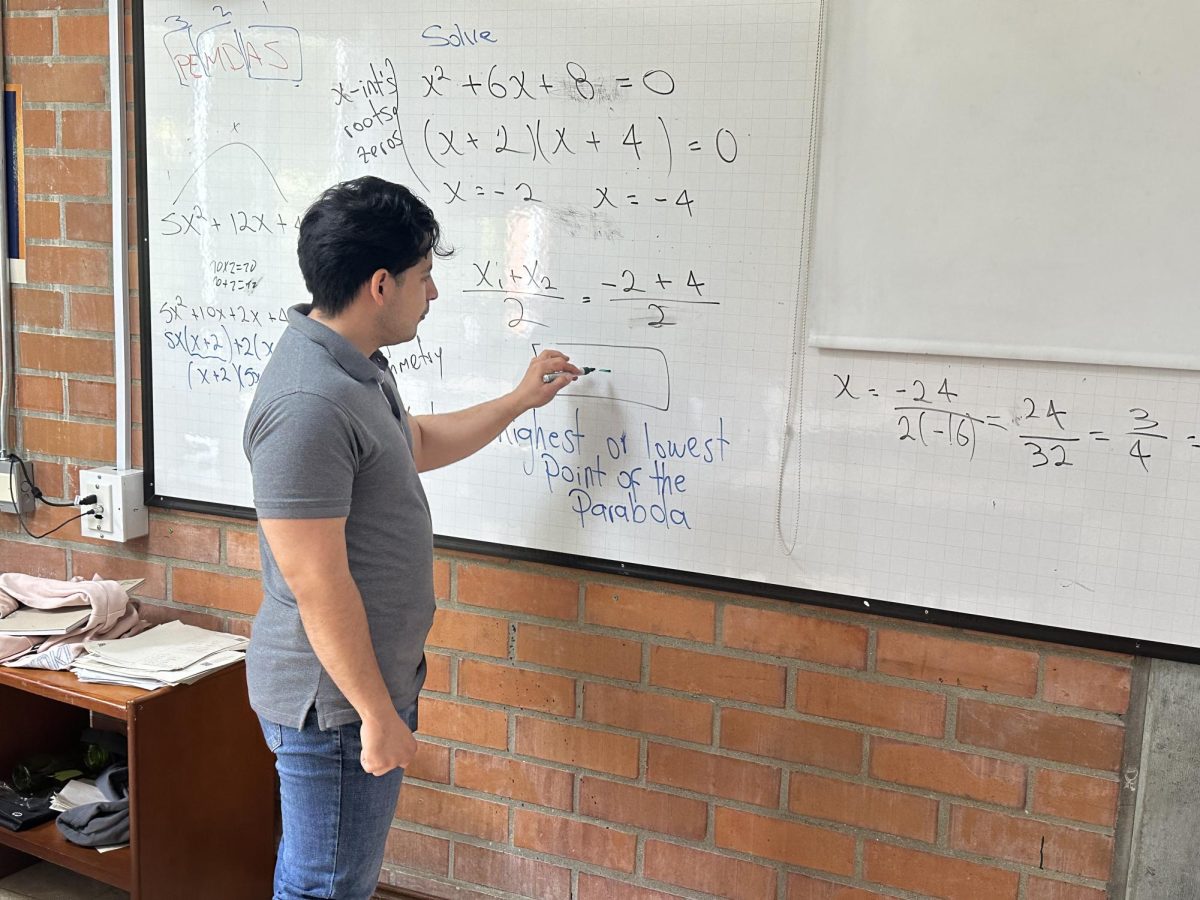
For most students, math is the hardest part of their academic career, so when difficulties appear in entire classes, the easiest thing to do is to point fingers at problems in how the curriculum is structured. Sandro Berrio, an Algebra II teacher and Head of the Math Department in HS, has noticed the same problem in students moving to higher-level courses. “When it’s a recurring pattern across a class, it points to a gap earlier in the curriculum.”
These gaps can make it hard for students to keep up with the material expected in their current course. Berrio thinks that these problems would be easier to identify if students could evaluate their classes. “Students should have more structured opportunities to share how they’re actually experiencing a class”. This could facilitate the department’s job of identifying problems that teachers or grades don’t reveal. However, Berrio also points out a challenge that comes with changing the curriculum. “Since we haven’t fully transitioned, it creates some inconsistency in how teachers approach grading and instruction day to day.”
Sandro’s concerns are also seen in student experience, as they notice problems but feel like they have limited influence over the problem. Juan Felipe, a 12th grade students that has experienced all required math classes to graduate, described how the pace of classes makes it difficult to understand important concepts before moving on: “sometimes the teachers are in a hurry to get to the next topic to meet a certain deadline, but I do not understand fully a topic so then when we start the next topic I am already behind given that most of the times the first topic is crucial for the second one.”
Even after filling those gaps, understanding the difficult concepts is still challenging, since Felipe explained that completing classwork was often a trade-off for understanding. “I was more worried of completing some notes than actually understanding the topic”. This experience connects with Berrio’s belief that students need more opportunities to give more feedback on their learning. “I think that students do not have enough voice to change the curriculum”
Although students may feel like they need more influence, the curriculum process shows that changing the curriculum involves factors beyond student experience. Sofia Montes, a member of the Student Curriculum Council, explained that student experience is considered when changing the curriculum: “Whenever a curriculum in a subject is going to be made, the first thing that is evaluated is how it would affect the students”.
However, curriculum changes also extend beyond the classroom, as Montes explains, “It would have to be heavily considered as changing the curriculum could mean that students don’t graduate with both diplomas.” This explains why changes may be difficult even after the problem is identified. At the same time, the lack of changes in HS raises the question of whether the curriculum must be updated. Montes said, “I have been part of the SCC for three years, and no math changes have been made in high school, but for elementary and middle school it was just one year ago. “
Overall, the information suggests that the curriculum isn’t poorly planned; it has a structured process that considers student experience, but there are gaps in essential skills, pacing, and student feedback, in which there is room for improvement.