


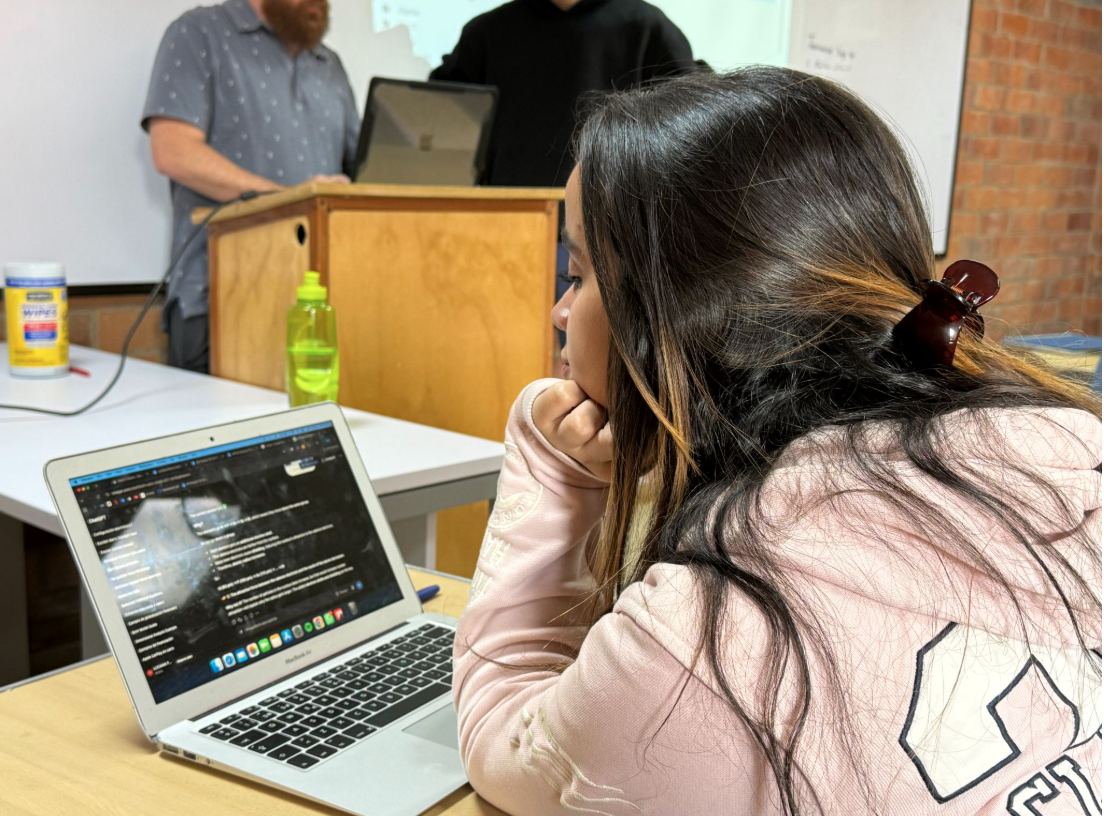
A difficult homework problem used to mean searching through notes, trying different methods, and sometimes sitting with confusion until something finally clicked. Now, for students with AI one tab away and TikTok on their phones, both answers and distractions can arrive in seconds. For three 12th-grade students at TCS, the speed of AI and short-form content is changing how they approach schoolwork, especially when assignments require time, patience, and sustained attention.
Luciana Pertuz regularly uses AI to understand difficult concepts and check her work. For her, one of its clearest benefits is how quickly she can move forward when she gets stuck.
“I think I complete assignments much faster now because I don’t stay stuck on one question for as long as I used to,” Pertuz said. Last year, while taking AP Calculus AB, Pertuz remembers getting stuck on homework problems at home. Instead of waiting until the next day to ask her teacher for help, she could ask ChatGPT to break the problem into steps and explain the part she did not understand, allowing her to continue working that same night.
That efficiency, however, has also changed how Pertuz responds when understanding does not come immediately.
“I have become less comfortable with being confused for a long time,” she said.
Pertuz sees that tension as a question of how she uses the tool, rather than whether AI itself is helpful or harmful.
“I think AI makes me a better student when I use it as a tool to understand something, but it can make me more dependent when I use it just to avoid doing the difficult thinking myself,” Pertuz said.
While Pertuz experiences the pull of instant answers through AI, Elisa Vasquez describes a similar challenge with instant entertainment. Instead of avoiding a difficult problem, Vasquez sometimes finds social media pulling her away from the work altogether.
“Every single weekend I say I’m going to study and then end up looking at TikTok or Instagram for at least an hour, and I lose valuable time,” Vasquez said.
For Elisa, the problem does not end when she puts her phone down. She believes consuming fast-paced content can affect how longer tasks feel afterward.
“Sometimes, consuming short videos makes my attention span last shorter so when I have to read long text, I get anxious and hyperactive and don’t wanna read it all,” she said.
Still, Vasquez does not describe the effect as absolute. Her experience with reading suggests that habits requiring sustained attention may counter some of what she notices from short-form content.
“I do think my phone has changed my attention span because I can’t focus as well as I could before,” Vasquez said. However, Elisa also pointed to reading as a habit that she believes has helped preserve her ability to sustain attention.
Pertuz and Vasquez describe different technologies, but both experiences revolve around speed: one offers immediate answers while the other delivers information and entertainment in seconds. Pedro Arango sees that expectation extending beyond individual apps to the way students approach information itself.
“I think students expect information to be much faster now,” Arango said.
When students become accustomed to getting information immediately, waiting and struggling through a difficult problem can feel less natural. Arango described the same impatience Pertuz noticed in herself, but connected it directly to the ease of getting an answer.
“Honestly, sometimes it makes me less willing to figure something out on my own because getting an answer is so easy,” he said.
For Arango, those benefits and drawbacks ultimately come down to how students choose to use the tools available to them.
“I think the effect depends on how students use the technology.”