


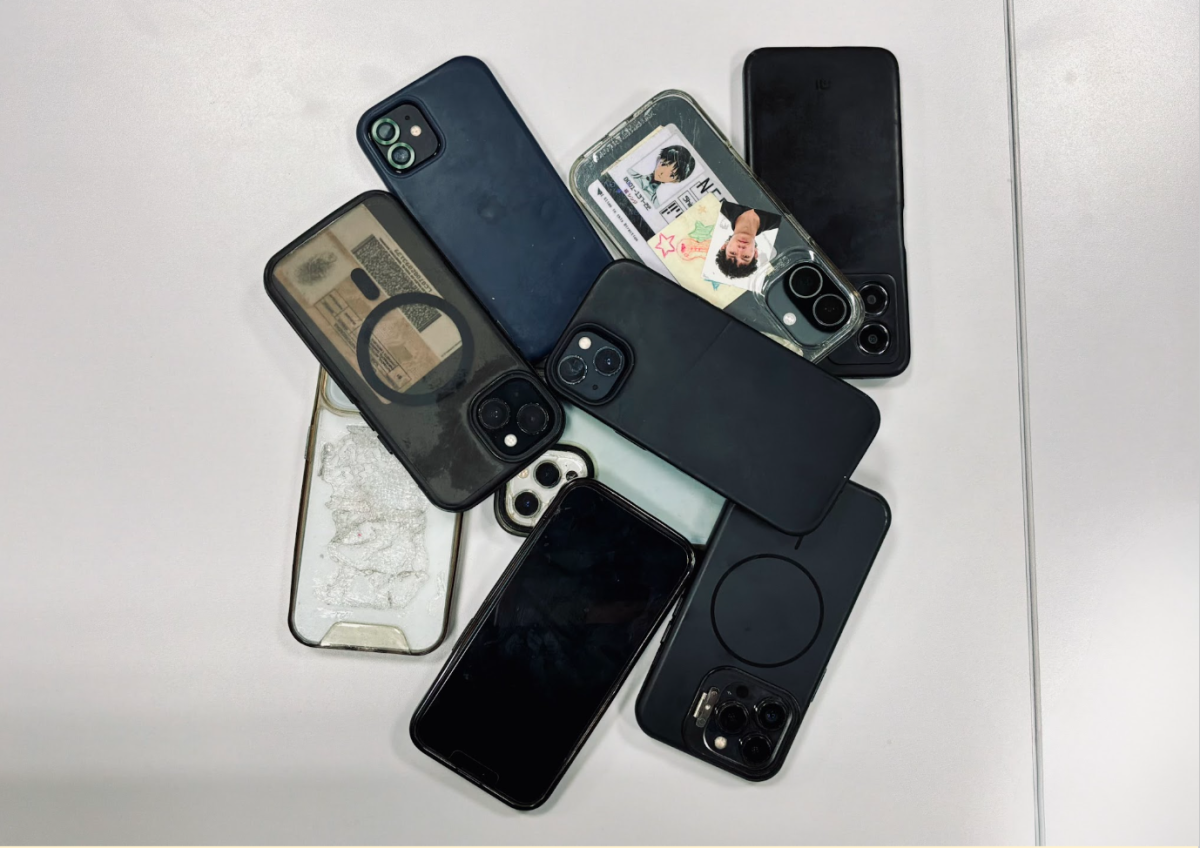
In August 2026, a new policy took effect at The Columbus School: zero tolerance for phones during class or transitions. The new rule has sparked different reactions among students and teachers, raising a question: why was it introduced?
After interviewing Ismael Valentin, the school’s vice principal, he explained some of the reasons behind the ban. In his response, he discussed brain drain, lost attention, task switching, and increased social connection: “Simply having a smartphone visible, even if turned off, drains cognitive capacity and limits deep focus…We want students to be able to work on their social skills without the interruptions or distraction of cell phones” (Valentin, 2026). But has this rule actually made a change? Valentin thinks it does; he says, “The ban has made an improvement in student attention during transitions because I no longer have to ask folks to stop using their phone to get to class” (Valentin, 2026). However, not all students agree that their focus has increased since the new rule was implemented. 12th grader Carolina Duque says the following: “Personally, I have actually felt less concentrated. When my phone is in my backpack, I can still hear or feel notifications, such as vibrations, which can make me more tempted to check it” (Duque, 2026). This shows why, for some, the phone ban can have the opposite effect.
On the other hand, Duque discusses why students’ phones are necessary during transitions. “I find it unreasonable that students cannot use their phones during transitions, since this is not instructional time. Cellphones are often necessary for communication, and without access to them, students can be disconnected from family members and other important situations for several hours. Personal or urgent situations cannot always wait until recess or lunch” (Duque, 2026). To add to the issue, the 12th grader also mentions situations where being aware of our phones matters for college applications. “Especially now, as many of us are beginning the university application process and making important decisions about our futures, there can be messages or situations that feel important and difficult to completely ignore until we are allowed to use our phones” (Duque, 2026; this quote was slightly modified for coherence).
A more intermediate perspective on the phone ban comes from teachers, including Camilo Hoyos, who teaches ISC and Entrepreneurship. “There are several activities in my curriculum in which phones can be useful learning tools. For example, students may create and edit videos about educational topics, record interviews and use technology to transcribe them, photograph physical work to include as evidence in reports, or upload content to their websites” (Hoyos, 2026). Phones can be essential tools in projects, video filming, and other class activities. Hoyos even mentioned an example from his class: “In Entrepreneurship specifically, students develop their own websites. Part of this process involves testing and editing their sites to ensure that they work properly on mobile devices. Having access to a phone allows students to experience their website from the perspective of an actual mobile user rather than relying exclusively on a computer simulation” (Hoyos, 2026).
Nevertheless, Valentin made it clear in his interview that this is no longer an option. “Some teachers expressed that they needed to adjust their curriculum because they often would ask their students to use their phones for different reasons. However, I think it helps that we have been clear that there are no exceptions, only for 2 factor authentication” (Valentin 2026). Despite the firm stance of the rule, Camilo Hoyos suggests in his interview that there might be room for modification, acknowledging the policy’s benefit while also signaling its weak point. “I think it is important to distinguish between reducing distraction and eliminating a technological tool altogether. Ideally, we should preserve the positive effects of the restriction while still allowing teachers to authorize phone use when there is a clear educational purpose” (Hoyos, 2026).
Mixed opinions exist in the TCS community about the no-cellphone policy: students argue they are necessary during transitions, teachers agree with the ban but want more flexibility for educational use, and administrators want to keep phones completely apart from class time.