


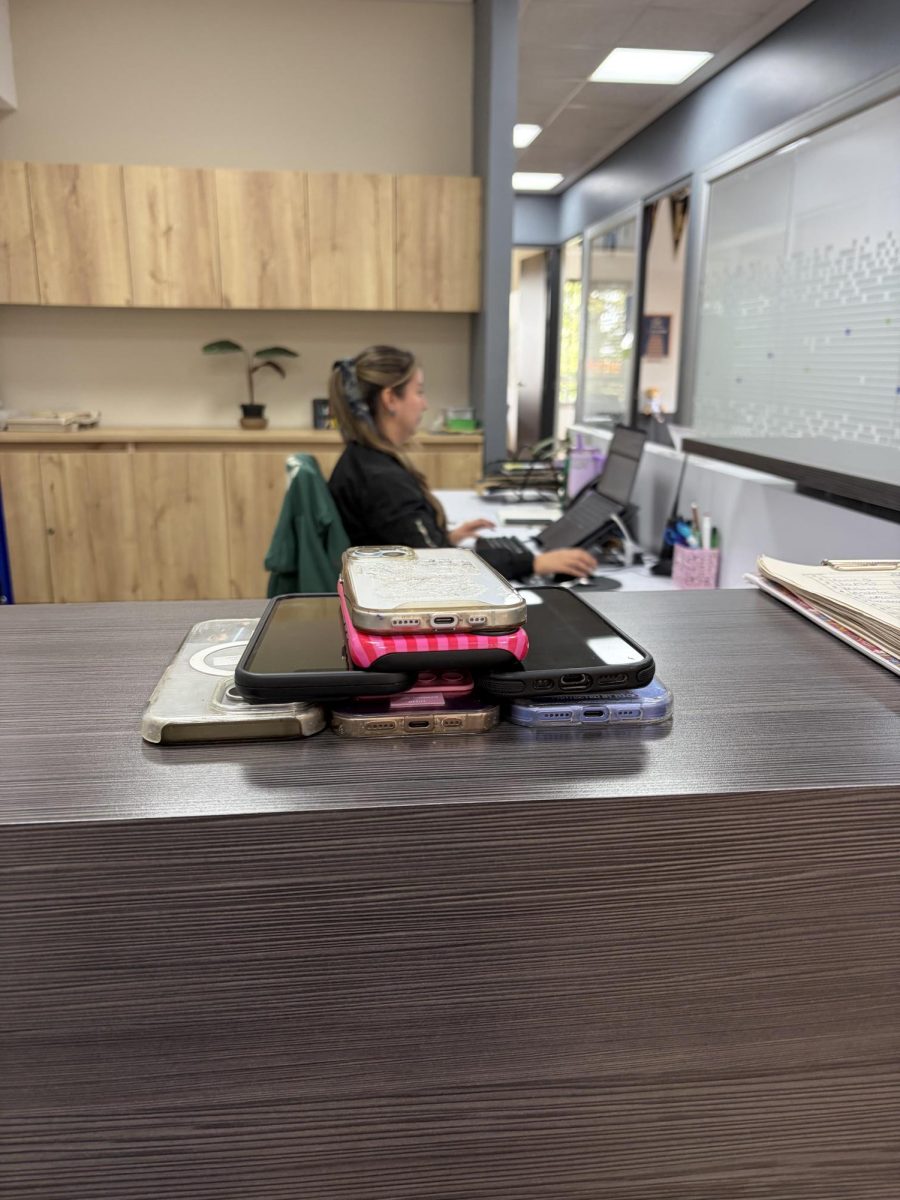
As of September, 76 phones currently sit in the TCS office as the school adjusts to a new phone policy implemented in the 2026-27 school year. The new policy restricts phone use to only during window and lunch. While the policy is designed to reduce temptation and encourage productivity, both staff and students are still figuring out the overlooked uses of phones inside the classroom.
The new policy has changed how students store and keep their phones on campus since the start of the school year. As of today, September 7th, the office has confiscated 76 phones. The policy has changed how teachers incorporate technology within their classes. Bradford Stretton, the AP Calculus teacher, has firsthand experience with how phones can be productive, while Senior Julia Ocampo believes the policy is creating a stricter environment. Both of these experiences raise the question: does the new policy generate enough benefit to justify the change?
“In the past I’ve definitely used them, particularly as a chronometer, and to measure the angle to the top of something,” Stretton said.
Teachers are not the only ones who are noticing the shift in the classroom flow and productivity. Ocampo, an NHS member of the school, has noticed that the previous policy gave teachers more freedom to decide when phones could be useful for classroom activities.
“The teachers had more freedom if they needed to use the student phones for classwork or an assignment,” Ocampo said.
While staff and teachers could choose when to use cellphones responsibly, the school had a phone pocket system in every classroom to maintain organization.
“They were effective in the sense that I could take attendance really easily,” said Stretton.
Although the phone pockets were convenient for teachers, Julia Ocampo viewed them differently from her perspective.
“Overall I think the phones if they’re in your bag are easier to access than in the phone pockets.” Ocampo claimed.
While the phone pockets facilitated the teachers’ organization and classroom management, Ocampo’s perspective highlights the importance of accessibility. This contrast between convenience and accessibility reveals a larger challenge with the policy: changing the established interactions students have with their devices during the day.
“Having students remember to not keep their phones in their pockets, because it’s such a natural thing to keep them in our pockets,” Stretton comments.
The TCS student community is still seeing whether the new policy is having a positive impact; window and lunch are only 70 minutes out of the 8 hours of school.
“I think it’s a minimal positive impact; it doesn’t make that big of a change. They should think about changing other things,” Ocampo said.
Students clearly have doubts about the impact of the policy, and there are other issues that the administration is overlooking with this new stricter policy. Stretton’s experience offers another side of whether phones are more disruptive than other technology used in class: “If students are listening to music while doing the practice problems, it’s less invasive to have a cell phone rather than a whole computer out.”
However, this policy goes beyond lessons, even going as far as to restrict cellphone use during transition periods, which are 5 minutes between classes.
“I think it is unnecessary to not be able to use them during the transitions as we need to check what’s going on and messages,” Ocampo claims.
For Julia, the restrictions during transition periods are really about her concern for the school’s approach to phones. Rather than eliminating their presence altogether, she believes the school should promote healthy and responsible use of the devices,
“I don’t see why they’re not changing other things about the school, like student entrepreneurs, and not the phone policy. High school students will always have phones; maybe they should work with that, not against it.”