


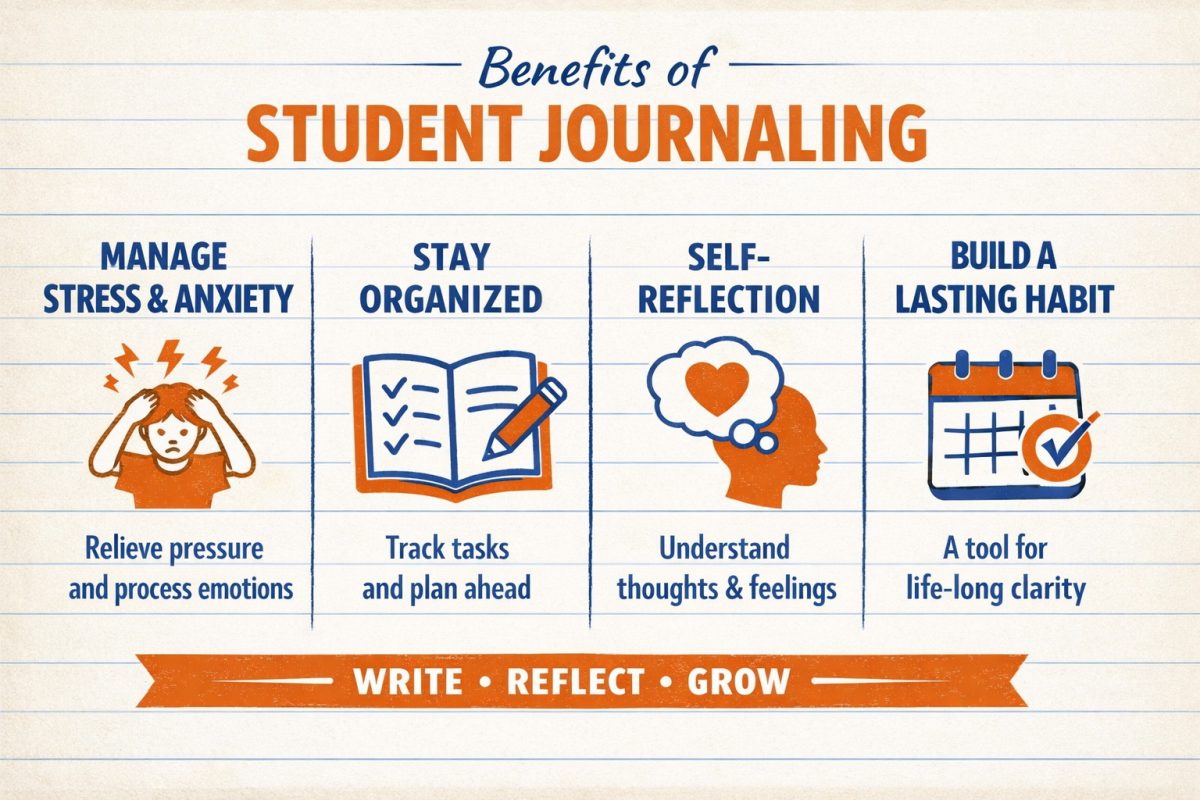
For many students, journaling has become an important way to understand their thoughts, manage stress, and stay organized. With social and academic pressures constantly competing for attention, students often feel overwhelmed and anxious. Through writing, many say they are able to reflect on their emotions, track their experiences, and feel more in control of their daily lives.
Rosario Suarez, a senior at The Columbus School, shared that journaling has helped her through difficult moments — academic, social, and personal.
“For me, it has been very important to write down everything going through my mind during vulnerable or stressful moments,” she said. “It helps me keep track of my emotions and thoughts and see them with clarity written down. It is also a way to look back at what you have gone through and the progress you have made.”
Suarez explained that physically tracking responsibilities in a journal has helped her manage pressure. As an active member of NHS and TOM, she balances a demanding schedule filled with academic and extracurricular commitments.
“I think that by writing down our thoughts, schedules, and emotions, we can physically see what we’re dealing with,” Suarez said. “It helps with how we handle the pressure of it all. It’s a really good way to plan ahead and understand what we’re feeling and what we can do about it.”
For Suarez, journaling became especially meaningful during her exchange semester abroad. Being away from home for the first time was challenging, and she initially struggled with homesickness. Writing gave her a sense of comfort and stability.
“Journaling helped me during my exchange semester,” she said. “At first it was very hard being homesick and away from home, and journaling helped me process my thoughts and feelings.”
She added that revisiting her old entries has become one of the most meaningful parts of the habit.
“I’m able to go back and read what happened and have my experiences written on paper,” she said.
Maria Jose Ramos, another senior, also described journaling as a way to slow down amid the chaos of school life. For her, it provides a quiet moment of reflection in otherwise busy days.
“I constantly write down my thoughts, and it’s a very positive experience,” Ramos said. “You get to have an introspective view and slow down to really think about what you’re feeling.”
Students are often balancing assignments, extracurricular activities, and personal responsibilities. Writing things down can help them visualize what needs to be done while also giving them space to reflect emotionally.
However, some students acknowledge that journaling requires commitment and focus.
“It’s very hard to really focus because our attention spans are very short,” one student, who asked to remain anonymous, said. “You have to be committed and focused in order to do it.”
Despite the effort it takes, Ramos emphasized that the emotional benefits outweigh the challenges.
Finally, Luz Adriana Ochoa, a journalist and communicator at ISA, explained that journaling has remained an important habit beyond her school years. Although she is no longer a student, she began journaling when she was younger and continues to rely on it in her professional life.
“In my work life, journaling has been very beneficial because it helps me visually understand what I have to do and keep everything organized,” Ochoa said. “It helps keep my mind clear, knowing exactly what I need to accomplish.”
She added that journaling during meetings allows her to remember important ideas and key moments, showing how the habit can evolve from a student coping strategy into a lifelong organizational tool.
Overall, students say journaling allows them to slow down, reflect, and better understand themselves. Whether used to manage stress, organize responsibilities, or record meaningful experiences, writing remains a helpful tool in their daily lives. What may begin as a way to cope with high school pressures can develop into a lasting habit that supports clarity, organization, and emotional awareness well into adulthood.