


Step into the STEM labs at The Columbus School and you will notice a major shift away from highly standardized conceptual problems, where every answer fits a predictable formula. Technology Director John Higuita designed a new curriculum to challenge this illusion of clean answers, thereby pushing students to develop true independent thinking. Higuita believes that the true value behind technology class is learning to slow down, embrace confusion, and navigate unlabeled chaos on their own. Building this rare resilience starts small-by helping students find personal meaning and real-world value in their everyday routines:
“I truly believed that the only way students were going to understand the importance of the class, was when they found it meaningful, that they considered it as a tool they could use in their daily routines, personal and school projects to solve their real-life problems,” Higuita explained.
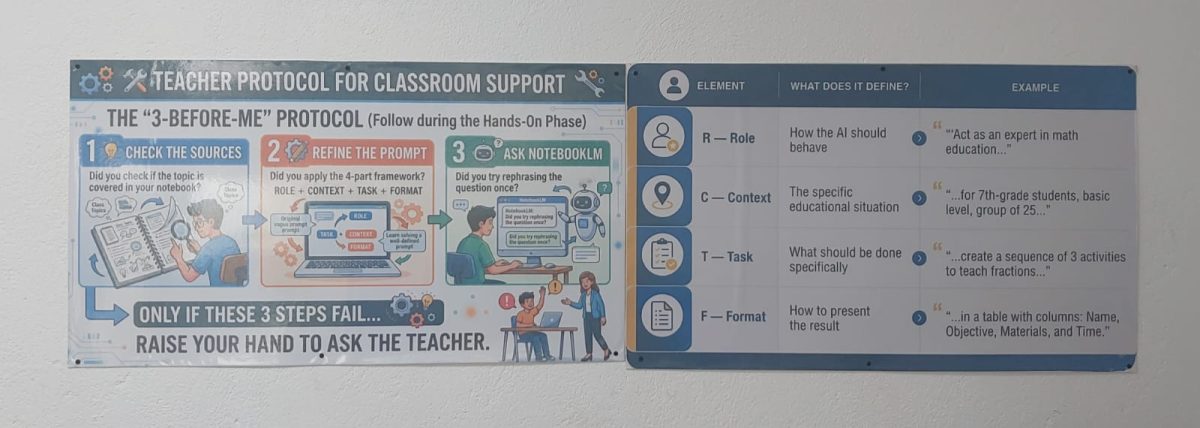
Finding that personal meaning is only the first step. Higuita first gives students structured instruction and practice, then gradually gives them more freedom to make decisions, test ideas, and learn from mistakes:
“At the beginning, students need clear instruction and practice, so they feel confident using the tools. After that, I try to give them more freedom to make decisions, solve problems, test ideas, and learn from mistakes,” Higuita added.
This philosophy points to a deeper reality within the learning process, shifting the focus from what is being taught to how it shapes the student’s mind. Higuita reveals that academic content is actually a strategic vehicle rather than the final destination:
“…the curriculum and the projects are just an excuse; what is behind that is the real goal of our learning-teaching process.”
That approach appears again across the hallway in the mathematics department, where students are challenged to look beyond formulas and understand the problem before deciding how to solve it:
“I remember a student trying to solve a probability problem purely by muscle memory, applying a formula she had memorized. When the numbers failed to add up, she finally stopped hunting for ‘the right equation’ and started looking at the reality of the scenario — what depended on what,” said Juan Carlos Rodriguez , an Algebra teacher in the mathematics department.
The same willingness to step back and reconsider an approach appears in Juan’s mathematics classroom. There, students are challenged to look beyond the formula and understand the problem before deciding how to solve it:
“The turning point came when she realized her calculated probability exceeded 1, an impossibility that forced her to step back. Seeing that the underlying structure was entirely different from what she had assumed, the solution finally clicked,” Juan continued
The connection between the two classrooms becomes clearer in the way Juan designs his own problems. Rather than rewarding students for immediately recalling a formula, he asks them to first understand the context and determine what information matters:
“I deliberately design tasks where context and data precede computation. The formula should be the final decision, not the starting line. By introducing non-standard framings or intentional ‘noise’, students are required to filter out what matters and interpret the situation before reaching for any statistical tool. ”
Normalizing this intense classroom confusion completely redefines academic struggle:
“…cognitive friction is proof of genuine thinking, not failure,” Juan emphasized.
The modern corporate landscape heavily validates this cross-curricular model, rewarding active execution over rigid memory:
“Nowadays, companies are looking for a workforce that can demonstrate knowledge but by doing; that they can solve, share and teach what they know with their workmates but also with the company,” Higuita argued.
Ultimately, this capacity to operate in disorder separates passive worksheet-reliers from autonomous thinkers:
“In the real world, problems never arrive pre-labeled with the method needed to solve them,” Juan concluded.