


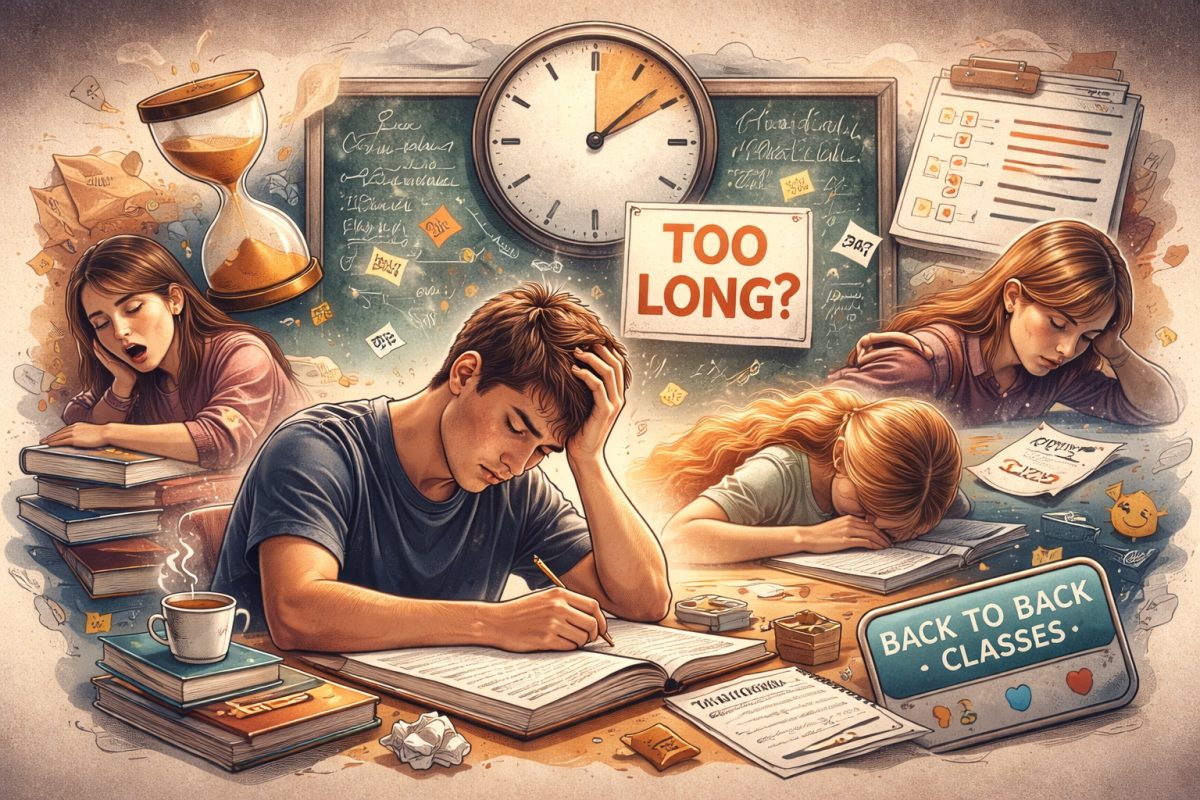
Many students and teachers at The Columbus School believe that long class periods make it significantly harder to stay focused and engaged during the school day. Extended periods in the classroom require students to maintain attention for long stretches of time, which can be especially difficult in traditional lecture-based settings. When focus is lost, students struggle to follow lessons, participate in discussions, and retain information. This challenge becomes more noticeable when classes last far longer than the average attention span of most students.
Not only for students, but also for some teachers, keeping focus during a long class depends largely on how the lesson is organized. “A class needs to be extremely well planned, or else as I start, I lose the focus,” said Camilo Hoyos, an ISC teacher at The Columbus School. He added that this challenge is not limited to students. “I can’t even pay attention to somebody talking to me for a long time,” Hoyos explained.
His perspective suggests that without frequent changes in activity, clear pacing, or interactive elements, long periods can quickly become ineffective. When lessons feel repetitive or slow, students may disengage early. Hoyos noted that this loss of focus can happen quickly, even if the class has just begun.
Another major issue students point out is the mental exhaustion caused by spending many hours in school. “Being in class all day until 3:15 p.m. is very tiring,” said Mariana Torres, a 12th-grade student at The Columbus School. She added that she “could literally fall asleep when classes are next to each other.” As students become more tired, it becomes increasingly difficult for them to stay attentive, especially during longer class blocks that demand constant concentration.
Many students also feel that long class periods exceed their ability to focus effectively. “I cannot focus for the full 70 minutes of a class, because it’s very long,” said Miranda Oliveira, a 12th-grade student. When attention fades halfway through a class, the remaining time often feels unproductive. “I even stop participating throughout the day because of how tired I actually get,” she added. Students may stop listening, take fewer notes, or mentally check out, which reduces the overall effectiveness of instruction.
Because of this, some students believe shorter class periods would lead to better learning outcomes. Miranda and Mariana explained that with less time in each class, they would be “more efficient and stay engaged.” Shorter periods could encourage teachers to focus on essential material and allow students to process information without feeling overwhelmed or mentally drained.
Fatigue becomes an even bigger problem as the day progresses. One student shared that after spending so much time concentrating, her “attention span doesn’t go as well toward the end of the day.” By the time students reach their later classes, their mental energy is already depleted, making long periods especially challenging. This decline in focus often leads to reduced participation and weaker comprehension.
In many cases, students do not even realize when they begin to disengage. Long class periods can cause students to feel worn out, stop participating, and lose track of what is being taught. When classes are scheduled back-to-back with little time to rest or reset mentally, the exhaustion becomes overwhelming.
Overall, these student experiences suggest that long class periods may be working against learning rather than supporting it. When students are exhausted, unfocused, and disengaged, participation decreases and understanding suffers. While longer classes may seem beneficial for covering more content, they often reduce the quality of learning. Shorter, more manageable class times could help students stay alert, focused, and actively involved throughout the school day.