


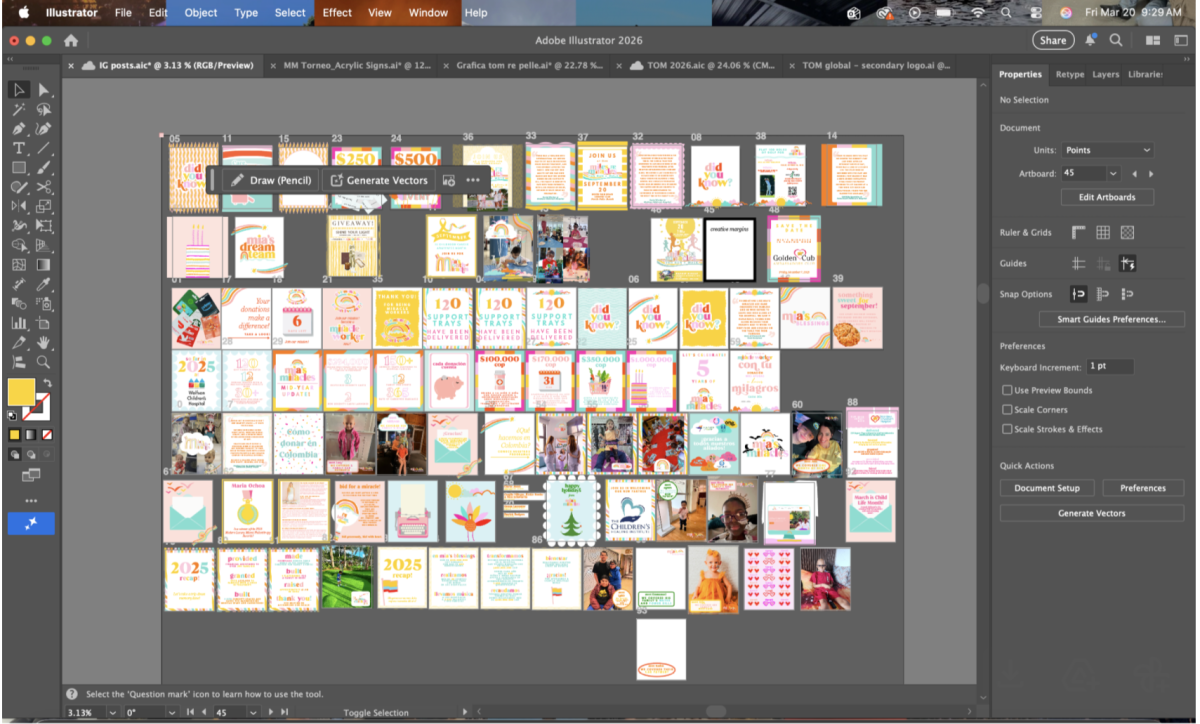
There is a moment before any teacher starts reading a project. You open a slide or a poster and immediately form an opinion. It looks clear or confusing. Organized or messy. Before the argument even begins, something has already shaped how seriously it will be taken.
At TCS, students are taught how to write essays, but not how to present ideas visually. Still, almost every class requires slides, posters, or campaigns. The expectation exists, but the instruction does not. As a result, design becomes a hidden skill that only some students develop.
This is especially visible in group projects. One person usually ends up doing the design, organizing layouts, choosing fonts, and making everything look right. That role is rarely recognized, but it directly affects how the project is perceived.
María Escandón, a TOM Marketing Leader, sees this in her work. “Design is the first thing people see before they even read about the event. If the visuals look professional, people already assume the event will be well organized” (Escandón). Her work shows that design shapes expectations before content is even considered.
She also emphasized consistency. “When I make brand guides for TOM, I try to keep everything consistent because that makes the whole event feel more serious and recognizable” (Escandón). This kind of structure is rarely taught outside of design classes, yet it influences how credible something feels.
John Higuita, a Creative Design teacher, explained that these skills extend beyond his classroom. “Many students use Illustrator to design posters, organize presentations, or create visuals for clubs and school events” (Higuita). Even without formal instruction, students rely on design across subjects.
He also noted how it changes thinking. “When students learn design, they start thinking about communication differently. They try to simplify information so people can understand it faster” (Higuita). Design is not just about appearance. It is about clarity.
Even so, it is often treated as optional. “Even when teachers say they focus only on content, a well designed project is easier to read and usually makes the ideas feel more structured” (Higuita). In practice, presentation still influences judgment.
Outside of school, this becomes even clearer. Susana Cadavid, a student and owner of Suki’s, uses design in her business. “We want to transmit experience, and the experience is also transmitted through the packaging and the good looking of the brand” (Cadavid). For her, design is part of what makes people trust the product.
She added, “When you see that a business has a good branding and a great visual identity, it shows one hundred percent more professionalism” (Cadavid). Before anything is explained, visuals already shape perception.
For Cadavid, branding also reflects effort. “It shows caring about my brand. It shows wanting to give customers the best” (Cadavid). The same applies to student work. A well designed project suggests intention and effort, even before it is read.
Across these perspectives, one thing is clear. Students are not judged only on what they say, but on how they present it. However, not all students are taught how to do this.
This does not mean everyone needs to become a designer. It does mean that visual communication should not be ignored. If students are expected to present ideas visually, they should be taught how to do it. Otherwise, design remains a hidden advantage.
At TCS, writing is treated as essential, while design is treated as optional. In reality, both shape how ideas are understood. And sometimes, how something looks is what decides whether it is taken seriously at all