


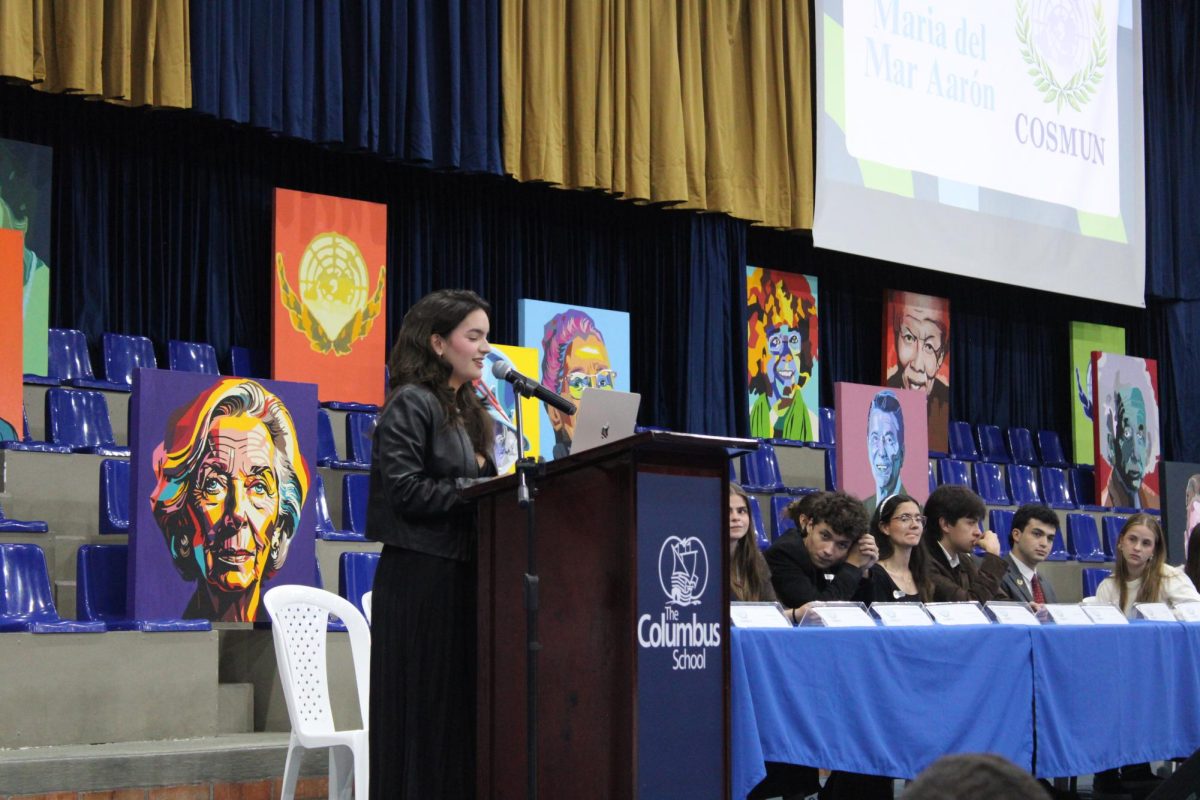
Hosting an event with more than 400 delegates is no small achievement. Behind the debates, organized committees, and smooth schedules of COSMUN 2026 lies a process that begins nearly a year in advance. While participants experience a polished Model United Nations conference, the reality is that such an event requires time, funding, and coordination across multiple areas of the school. Understanding these efforts reveals what it truly takes to bring COSMUN to life.
To begin with, COSMUN operates on a scale that demands both financial and organizational support. According to Columbus Life head of extracurriculars, Faber Ortiz, “At the moment, COSMUN, considering 2025 and 2026, has an operational cost of approximately over 110 million pesos. This includes both costs and expenses related to running an event of this scale.” This figure reflects the magnitude of the conference, covering logistics, materials, staffing, and essential services. Without this level of funding and institutional backing, hosting an event of this size would not be feasible.
However, the cost of COSMUN extends beyond finances. A large part of the responsibility falls on student leaders, who dedicate significant personal time to the event. Sofia Thiriez, senior (2026) and head of logistics, shares, “Probably maybe about 20 hours of my free time it takes to build this amazing community and this amazing event.” Balancing these responsibilities with schoolwork can be challenging. She adds, “I need to make up a lot of work… Even though I’m excused, I still need to complete the work, so I have a lot of work to do at home, and then I get very behind.” These experiences show that leadership in COSMUN goes far beyond a typical extracurricular, especially considering the involvement of over 250 TCS students.
Logistics is one of the most critical—and delicate—components of the conference. Even minor issues can affect the entire event. As Thiriez explains, “Giving out the lunch or the snacks, if the person who is providing us the food is either late or slow, then it can ruin the whole dynamic and the whole process.” This highlights how much the event depends on timing and efficiency. A single delay can disrupt schedules and impact the delegates’ experience.
The complexity of coordination further illustrates the scale of the operation. Ortiz describes it as a “job that requires coordination across many areas. We have to carry out consultations related to occupational health and safety, supplier management, security matters, and operations development, which are the teams that support and look after things internally.” This shows that COSMUN is not simply organized by students—it involves structured planning and collaboration with multiple departments. From safety protocols to supplier coordination, every detail must be carefully managed.
Planning is also a continuous process that extends far beyond the days of the conference. Ortiz explains that “basically, it covers everything from the planning phase to how we are going to operate the event as such, ensuring that the planning and execution are carried out during the event.” This reinforces that COSMUN is built over months of preparation, where each decision directly impacts the final result.
Beyond logistics and organization, COSMUN plays a key educational role. David Murphy, general sponsor, highlights the academic support involved: “In that regard, we review guides. I have students that send me their position papers as well, just to go through them for accuracy and detail things like that.” This mentorship helps students strengthen research and argumentation skills, improving the overall quality of the conference.
In addition, the experience encourages independence. Murphy explains, “I think it teaches self-sufficiency, right, and that there’s not necessarily a teacher telling you how to do this, what exactly to do.” This environment pushes students to take initiative and develop problem-solving skills, preparing them for challenges beyond the classroom.
COSMUN also creates opportunities for in-depth learning beyond the standard curriculum. As Murphy notes, it involves “things that we don’t necessarily have a specific subject or curriculum that dives deep into.” This allows students to explore global issues and perspectives that are not typically addressed in traditional classes, making the experience both academic and practical.
Taken together, these perspectives show that COSMUN 2026 is much more than a school event. It is a major undertaking that depends on resources, planning, and commitment. From the financial investment required to the time and effort contributed by students and staff, every aspect reflects a shared dedication to making the conference possible.
Ultimately, COSMUN 2026 proved to be a resounding success, having been held at TCS from March 3–6. This achievement was the result of strong collaboration between students, organizers, and the continuous support from TCS. Although the costs were high, they allowed the event to provide a meaningful experience for hundreds of delegates. The dedication of the base team which are logistics, secretariat, and press was essential in ensuring everything ran smoothly, while the guidance of teachers and the support of sponsors played an equally important role. Without their contributions, the event would not have been possible. In the end, COSMUN stands as a testament to teamwork, leadership, and collective commitment.