


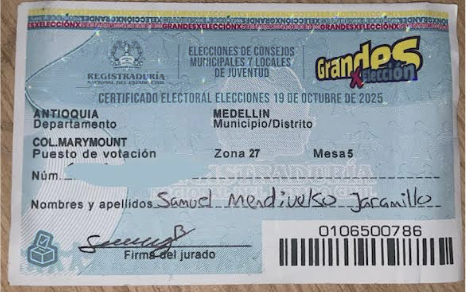
On paper, Youth Councils in Colombia sound like a great idea. They serve as a democratic space where young people can influence policy and express their voice. But in reality, they’ve become the opposite: a hollow project filled with wasted potential. In 2025, out of 11.7 million eligible youth, only 12.8% voted. The government called this progress, but I call it proof of failure. With programs like “Soy Joven, Soy Bogotá” preaching slogans such as “Participar también es transformar”, the message sounds inspiring. Unfortunately, the system behind it isn’t.
I believe Colombia’s Youth Councils are a failed political experiment — symbolic, ineffective, and disconnected from the reality of young people. They pretend to represent us, but they don’t listen, they don’t deliver, and they certainly don’t change anything that truly matters.
According to La Silla Vacía, an online independent journalism outlet covering Colombian politics, only 12% of eligible youth voted in 2025, and just 16.9% even knew what the councils were. That’s a national embarrassment. Junior Tommaso Orsini, who follows political issues closely, told me, “Since the first election in 2021 I’ve seen the council elections in Colombia, I’ve never noticed a real impact or change made by the council members’ decisions.” Later, Orsini added, “If the Youth Councils had a real impact on society, which so far they haven’t, more people would actually care.” He’s right — people ignore what’s irrelevant. For example, Tommaso did not vote.
La Silla Vacía also reported that the government set up 9,000 polling stations and 19,000 voting tables nationwide. That’s a massive investment for a turnout below 13%. As Orsini said, “It feels like the government is just using this program to make young people feel important or represented, without achieving actual change.” Meanwhile, independent journalists from Página 10 pointed out that although the system is improving technically — with null votes dropping from 23% in 2021 to just 2% in 2025 — none of this translates into actual influence. The state measures effort, not outcome. It should be the opposite.
Even when people vote, their voices go nowhere. The Youth Statute requires the councils to meet twice a year with mayors and governors, yet Página 10 revealed that this “rarely happens.” The article summarized it perfectly: “No se trata de convencer a los jóvenes de votar, sino de garantizar que lo que votan sirva para algo.” Another junior, Pablo Fernández, who actually voted, said, “Yes, they do represent young people, but not very well communicated.” Later he admitted, “Honestly, I haven’t noticed any changes.” That’s because there aren’t any.
Some might argue that Youth Councils are improving — that participation rose from 10.4% in 2021 to 12.8% in 2025 — and that this shows progress. But if young people still see no impact, what’s the point? As Fernández mentioned, “It’s good that the government supports these initiatives, but they should be done in a more engaging way.” I’d go further: engagement isn’t the issue, purpose is. Until the councils have real power or results, it doesn’t matter how many posters or social media campaigns are made. We’re voting for nothing.
The government loves to talk about empowering youth, but it refuses to actually give us influence. Colombia doesn’t need more photo ops or symbolic councils; it needs youth participation that counts. After hearing voices like Pablo Fernández’s and Tommaso Orsini’s, I’m convinced: Youth Councils are a waste of time and money. Either give them real decision-making power or stop pretending they represent the Colombian youth at all.