


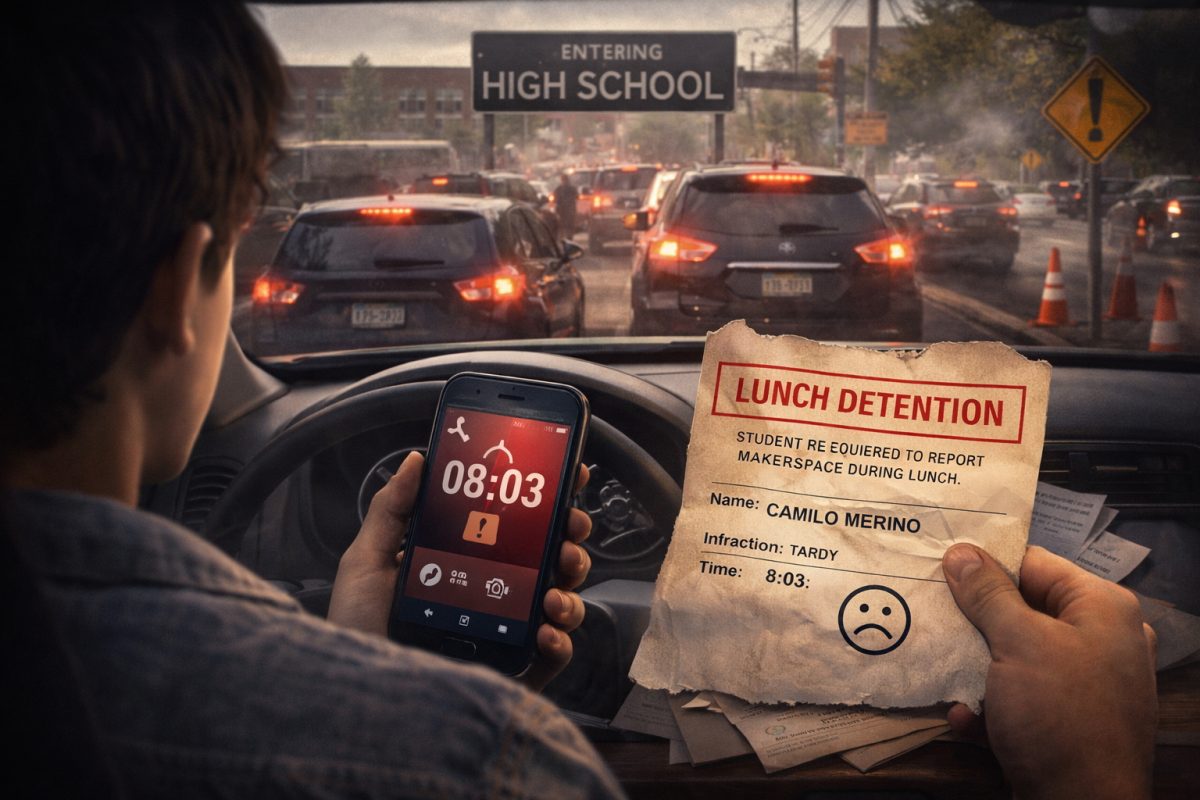
The school’s tardy policy has created strong reactions among students and staff at The Columbus School, located in Medellín, Colombia, especially when it results in lunch detention as a consequence of being late to class three times.
Many students feel that the consequences are too strict, especially in situations that are beyond their control. Some argue that it is unfair to spend 30 minutes of their lunch time in detention when that time would normally be used to socialize and eat with friends. Students who receive a lunch detention are required to eat in the Makerspace, where detention is held during lunch.
The purpose of the policy, administrators say, is to reinforce punctuality and accountability. However, for some students, the consequence feels disproportionate to the offense.
Matías Gaviria, a 12th-grade student, described his experience by saying, “Yesterday I was late and I had to go to the office to get a pass, and after that I had lunch detention.”
Several students pointed to traffic as a primary reason for arriving late to school. “I don’t think it’s fair because sometimes the traffic is very bad, so it’s hard for me to calculate the exact time I need to leave my house,” said Camilo Merino, a 12th-grade student.
Matías Gaviria, also a student, shared a similar concern. “Sometimes it’s hard to be on time because of traffic jams and too many cars entering the school,” he said.
Even when students arrive only a few minutes late, they receive lunch detention as a result.
The policy does not make exceptions for traffic delays, which many students believe is unfair. “It’s really unfair because we were late due to a traffic jam and still got lunch detention,” Camilo Merino said. Students argue that traffic conditions can change quickly and that it is not always possible to predict how long the commute will take.
For some families, leaving much earlier is not realistic because of work schedules and other responsibilities. Additionally, because of where The Columbus School is located, many families must take Las Palmas Avenue, which often has accidents weekly, and students cannot control those circumstances.
Lunch detention also affects students socially and emotionally. Matías Gaviria said, “Lunch detention affects me because lunch is the only time I can eat and talk with my friends.” Since lunch is often the only free time during the school day, students feel frustrated when it is taken away. Some students say the punishment feels more discouraging than helpful.
From the staff perspective, however, the policy appears to be working. Camilo Hoyos, a Technology and Innovation teacher, noted, “I have noticed that students’ sense of urgency has increased since the tardy policy started.”
He also added that before the policy, students walked slowly to class because they had no consequences for arriving late. According to this teacher, punctuality is a skill that prepares students for future careers and responsibilities.
Although the policy may increase urgency, students believe adjustments could make it fairer. One suggestion was that tardies should be accumulated before punishment is given. “A fair consequence would be if tardies were accumulated, and the punishment depended on how many you get,” Camilo Merino explained. By balancing accountability with an understanding of real-life challenges like traffic, the school could create a system that supports responsibility while also considering student well-being.
The tardy rate at The Columbus School has decreased, but students feel the policy is not fair and suggest that there should be a different consequence for arriving late to class.