


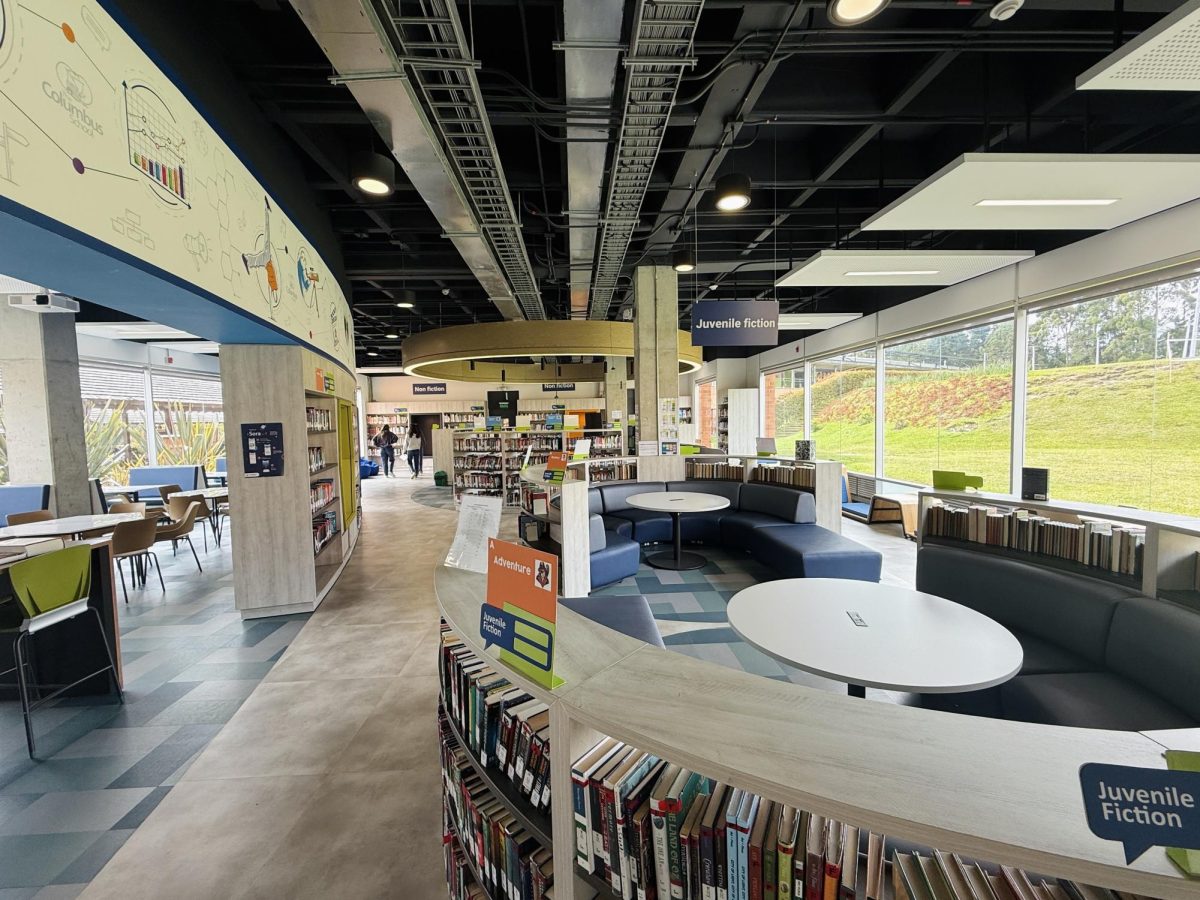
On any school day, the library at The Columbus School can feel very different depending on the time. Sometimes it is quiet and focused, with students working and studying. Other times, it is full, loud, and hard to find a seat. Even though study spaces are meant to help all students, the way they are used raises questions about access and fairness.
The library is meant to be a place where students can concentrate and get work done. Librarian Lina explained that this is intentional. “These rules are not just norms, but tools so that all students can use the space in a productive way,” she said. By keeping the space quiet and focused on academic work, the library tries to support every student.
It also offers resources that students may not have in other places. Lina the librarian said, “They offer a quiet place with access to resources where students can concentrate, research, work in groups in an organized way, and receive guidance when they need it.” This shows that the library is not just a place to sit, but an important space for learning.
Many students say these spaces really help them. Irene Hinestroza explained how being in a study space improves her focus. “Sometimes it really helps me focus more than being at home, where there are more distractions,” she said. For students who struggle to concentrate, the environment makes a big difference.
Irene also shared how it helps her finish her work. “Since I struggle with homework sometimes, being in a study space makes it easier to concentrate and actually finish my assignments instead of getting stuck or procrastinating.” This shows how important these spaces can be for students who need extra support.
However, it is not always easy to use these spaces. During busy times, like test weeks, the library can get very full. This makes it hard for some students to find a place to study, even if they really need it.
Another reason access can feel limited is because student athletes are allowed to use the library during P.E. For them, this time is important. Mariana Torres explained, “It’s a space that helps me stay on track academically when my sports schedule is demanding.” Since athletes spend a lot of time training and competing, they need time during the school day to keep up with schoolwork.
Mariana also talked about how hard it can be to manage everything. “One of the main challenges is managing time. Training, competitions, and travel can take up many hours during the week, so sometimes it’s difficult to balance that with homework, studying for exams, and projects.” This shows why having access to the library can really help them.
Still, not all students think the system is fair. Some feel that access to study spaces is not equal. Irene Hinestroza said, “I kind of understand that athletes have busy schedules with practices and games, but I also think study spaces should be fair for everyone.” Her opinion shows that there is some tension between different student needs.
At the same time, Mariana shared a different perspective. “I think the library access is not really special treatment but rather a way to support students who have demanding athletic commitments.” This shows that the policy is meant to help, not give an unfair advantage.
Lina also explained that the goal is to support all students. “The goal of the library’s policies is for the space to function as an appropriate study environment for everyone.” Even though this is the intention, it does not always feel that way for all students.
In the end, study spaces at The Columbus School are clearly helpful, but not always equally accessible. They help students focus, stay organized, and complete their work, but limited space and different needs can create challenges. As more students depend on these spaces, finding a better balance may be the key to making them work for everyone.