


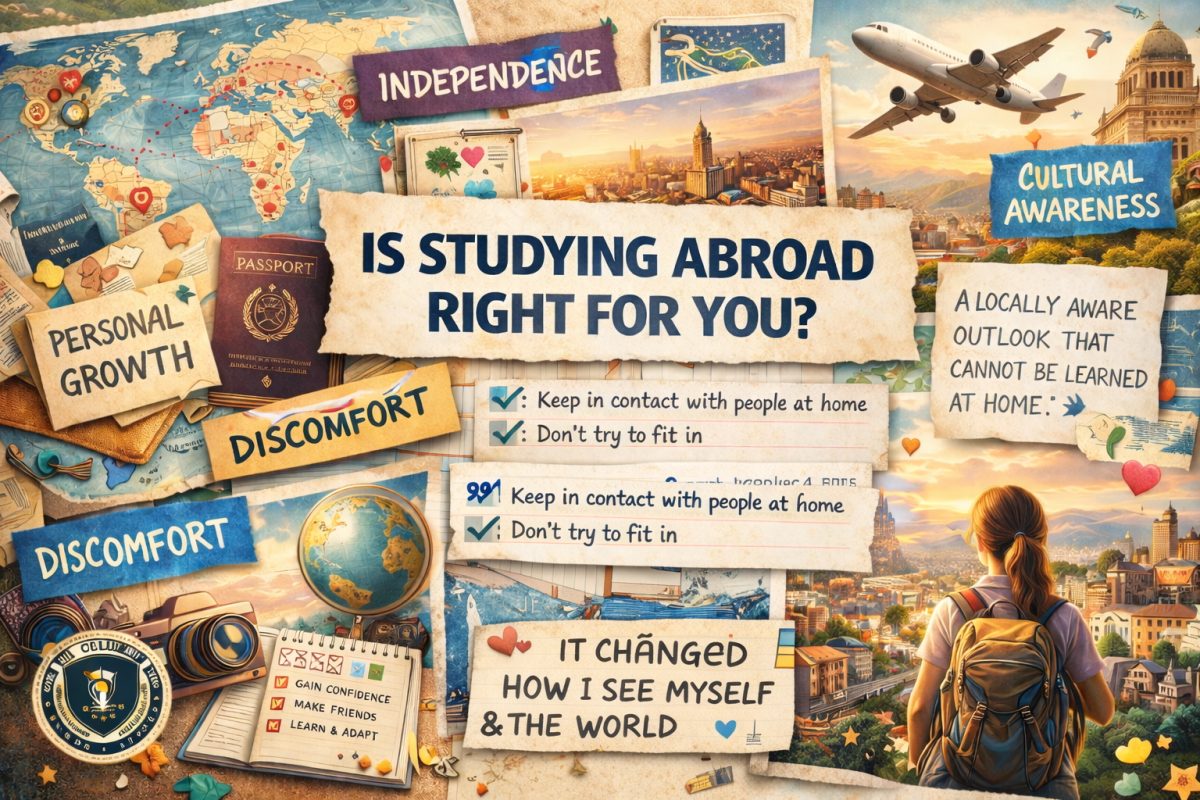
When the finish line of high school feels close and new opportunities begin to appear, many TCS students find themselves in the months of January and February wondering whether studying abroad is the right choice. In today’s world, where cultures increasingly intertwine and cross-cultural awareness has become central to a meaningful education, these decisions carry real weight.
For many students at our school, studying abroad has gone far beyond classrooms and textbooks. Through their time abroad, they describe moments of discomfort, growing independence, and personal growth that reshaped how they see both the world and themselves. While studying abroad is often viewed simply as an opportunity to travel, I believe it is something deeper: during formative years, when identity and independence are taking shape, living abroad challenges students to step out of their comfort zones, confront hardship, and develop a broader, more culturally aware outlook that cannot be learned at home.
As the world becomes increasingly interconnected, education must extend beyond academic instruction to prepare students for unfamiliar challenges, diverse perspectives, and personal responsibility. Experiences that place students outside their comfort zones often foster the greatest growth, encouraging resilience, independence, and self-awareness.
I believe studying abroad embodies these qualities, making it one of the most powerful educational experiences a student can have, as it builds character, strengthens independence, and deepens cultural understanding.
One of the strongest arguments for studying abroad is the way it expands students’ understanding of the world beyond their immediate surroundings. Andrew Shainker, a journalism teacher at The Columbus School who has traveled to 102 countries, explained that “experiencing other cultures allows us to gain open-mindedness, to connect, and to be able to break down stereotypes, judgments, and biases.” He added that without exposure beyond family or friends, “we’re missing that opportunity to be able to understand how other people live, think, and act.”
His perspective is supported by research: according to a 2018 study by the Institute for the International Education of Students, 98% of students reported that studying abroad helped them better understand their own cultural values and biases, and 94% said it improved the way they interact with people from different cultures. In a world where collaboration across cultures is increasingly expected, these experiences become especially meaningful. By confronting unfamiliar perspectives and ways of life, students develop empathy and awareness that cannot be fully replicated within their own community.
Studying abroad is not always easy, but it is precisely the challenges that make the experience transformative. Rosario Suarez, a 12th-grade senior, shared that the hardest moment came when her parents left, describing it as a shock and a moment of complete loneliness. However, once she began to settle in, she realized the experience changed her permanently, making her more independent and self-sufficient. Suarez also noted that people often avoid discussing the difficult moments, even though, as she explained, “it is in those moments that we are able to grow.”
Her experience highlights how discomfort can foster resilience, maturity, and self-reliance—qualities that are essential for the transition to college and for navigating adulthood. Learning to adapt, solve problems independently, and manage emotional challenges prepares students not only for academic life, but also for long-term personal and professional success.
For some students, studying abroad becomes a turning point in how they understand and build relationships. Maria del Mar Aaron, a senior at TCS, shared that her biggest challenge was starting her life almost from scratch and stepping outside her comfort zone. However, it was through this process that she discovered her love for meeting new people and forming meaningful connections.
Aaron emphasized several pieces of advice for students preparing to study abroad, noting that “it’s very important to keep in contact with everyone at home, and you should make one or two really good friends.” According to her, the key to forming meaningful friendships is “not trying to fit in,” explaining that this approach makes it easier to “find a group of people that will suit you and your personality.” Exposure to new people and the process of building friendships gave her the confidence to apply for college in the United States.
This experience of stepping beyond familiar environments is fundamental to personal growth, as it develops interpersonal skills that students carry with them throughout life. In fact, recent data from the Institute for the International Education of Students shows that over 90% of students report lasting improvements in how they interact with people from different cultures, highlighting the long-term impact of these experiences.
Some argue that remaining at home is the wiser choice, as it allows students to maintain close support systems and focus on building local networks that may benefit them academically and professionally. Staying within a familiar environment can feel safer and more strategic, particularly during a time when stability is often prioritized.
However, this perspective overlooks the broader value of international experiences. Studying abroad exposes students to unfamiliar cultures, ideas, and ways of thinking, fostering adaptability and open-mindedness that are difficult to develop in familiar settings. Rather than limiting students’ opportunities, studying abroad equips them with transferable skills that strengthen both personal development and long-term professional success.
Studying abroad is more than an academic opportunity; it is a formative experience that cultivates character, independence, and cultural awareness essential to education in the modern world. The voices from our school community demonstrate that meaningful growth often emerges from stepping into unfamiliar environments and engaging with perspectives beyond one’s own.
As students and future citizens, we should be encouraged to pursue opportunities that challenge us, broaden our understanding, and prepare us to participate thoughtfully and responsibly in an increasingly interconnected world.