


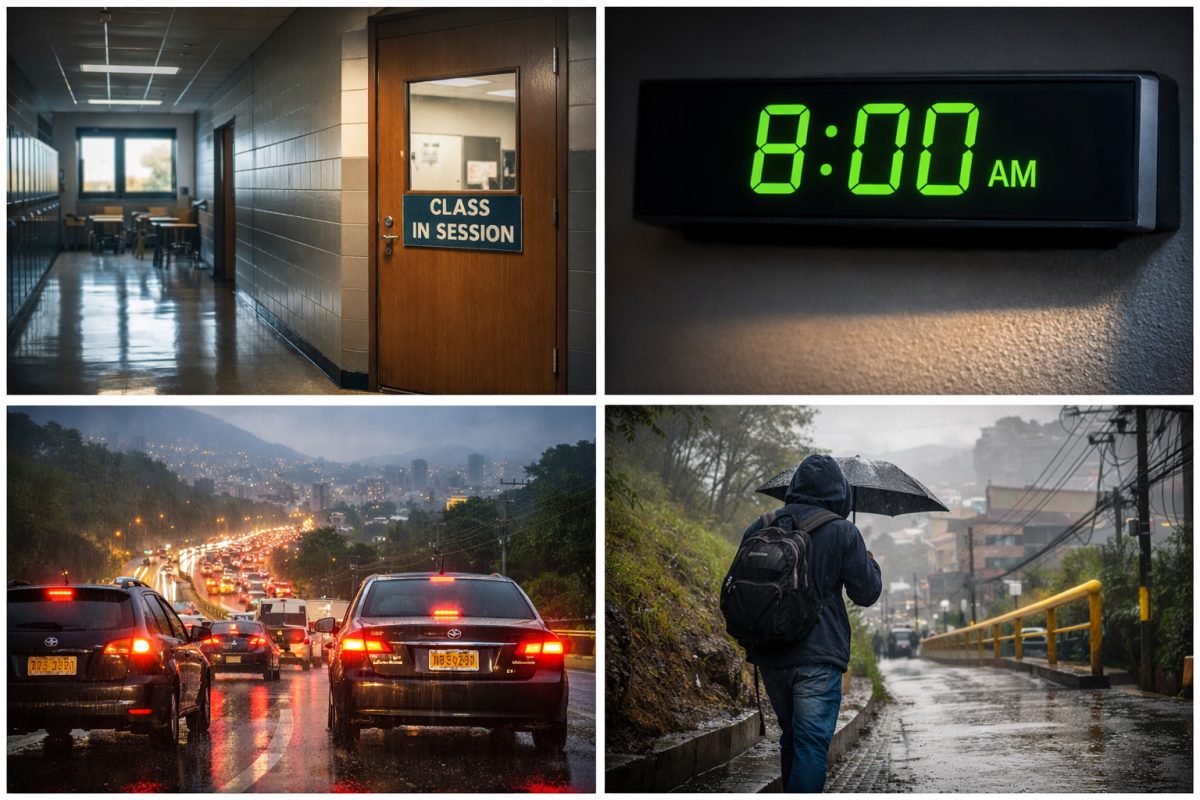
For students racing through traffic, stuck in morning rain, or circling the parking lot for a spot, 8:00 a.m. now feels less like a start time and more like a deadline. In the last week of January, The Columbus School implemented a new tardy policy requiring teachers to close and lock their classroom doors exactly at 8:00 a.m., sending any late students to the office for a pass before they are allowed to enter. As transportation issues, weather, and parking challenges continue to affect arrival times, students across campus are reacting in different ways to the change.Andrew Shainker, a high school journalism teacher, believes the policy could have long-term benefits for the school community.
“Hopefully, in the long run, it creates a more holistic learning environment,” Shainker said.
However, he also explained that not all late arrivals are within students’ control. Shainker pointed to recent situations that affected how people were able to get to school.
“Depending on where you live, there are some time factors that are out of your control. Just take a look at yesterday — we had those landslides and over flooding — you know that affects different individuals depending on the route that they take with their car,” he said.
For that reason, Andrew believes the policy should not be applied in exactly the same way for everyone, and that implementing a new policy that is strict in school is not fair for all students.
“I think that with a policy, there can’t just be one uniform rule; there has to be a little bit of grace,” he said.
María del Mar, the 12th-grade STUCO representative, shared a personal experience that shows how the policy can make small delays turn into bigger problems. She explained that one day she brought her car to school because she was leaving early. Since she had to park outside and walk in, she arrived about two minutes late to class. Because of the new tardy policy, she had to wait in a long line at the office to get a pass, which made her even later to her physics class, where she had a very important exam. For María del Mar, this experience was a clear example of how this policy still has its holes and is nowhere near perfect or practical.
She also described traffic conditions on Av. Las Palmas, and how the constant accidents on these roads in the mornings make arriving on time harder.
“The traffic jams on Las Palmas, especially in the mornings lately with all the rain and everything, make the roads more congested,” she said.
According to María del Mar, the policy has also changed how students experience the start of the school day at The Columbus School.
“The policy makes me rush a lot, and it has also taken away some of the socialization time in the morning,” she said.
Matías Yepes, a 12th-grade student who comes to school by car, also said that many of the reasons students arrive late are outside their control.
“Some factors that make me arrive late to school are the traffic jams on Las Palmas. There is a lot of congestion and cars early in the mornings, which makes it difficult to get on time; it’s not a factor we can decide,” he said.
He believes the policy does not treat everyone equally, especially students who have to walk longer distances because of parking difficulties when arriving by car.
“It doesn’t treat everyone fairly because there are some people who need to walk to school because we cannot park inside, for example, from the peatonal or through the portería, which is minimum like seven minutes just to reach high school and enter the school,” Matías said.
When asked what changes he would make to the newly implemented policy, Matías suggested a short waiting period before closing the classroom doors.
“I believe that at least ten minutes of waiting would be fair, because if they close the door instantly, I don’t think it’s fair,” he said.
While students and teachers recognize the intention behind the tardy policy, their experiences show that traffic, weather, parking, and walking time continue to make punctuality difficult for students at The Columbus School. Many believe that flexibility and understanding about different routes and possible morning inconveniences are necessary to make the policy fair for everyone.