


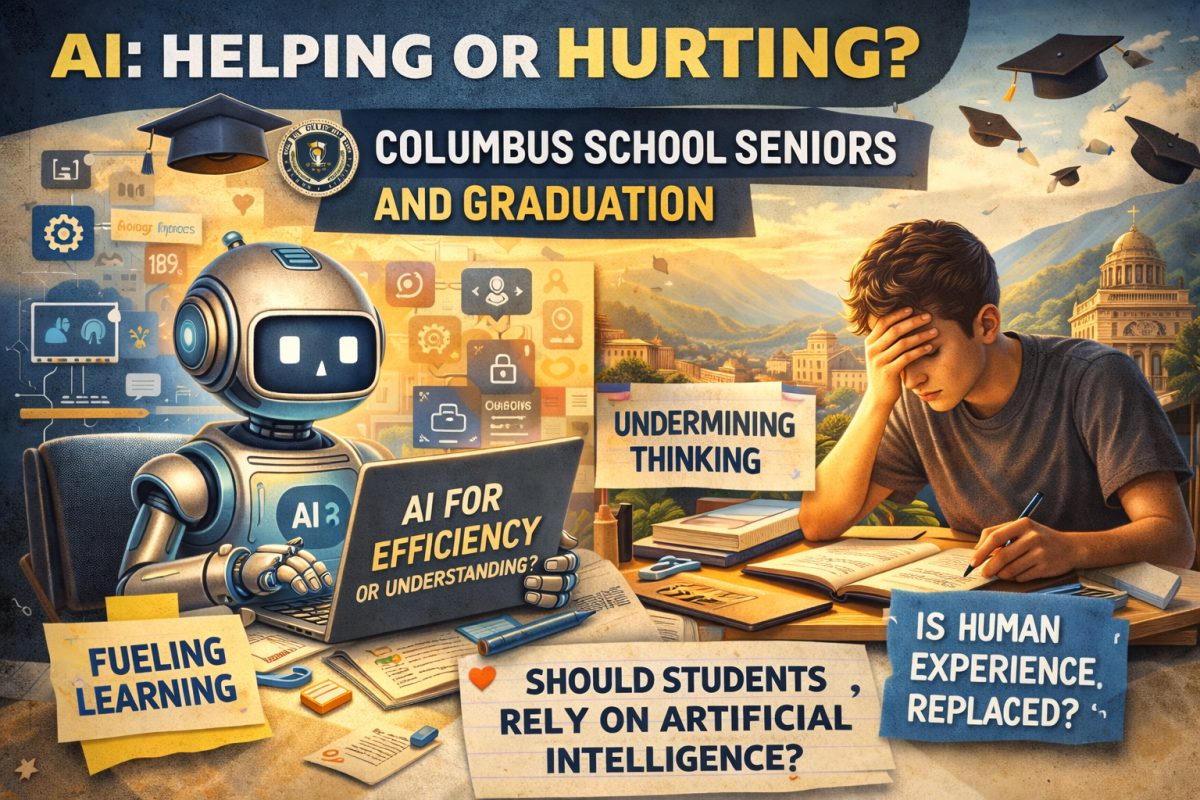
As Columbus School seniors prepare to graduate in June, artificial intelligence is becoming an increasingly common part of how they get ready for university. Among seniors, AI is shaping study habits, homework completion, and ideas about learning itself, raising both optimism and concern about what this means for the future. At The Columbus School, seniors are using AI in classes such as English, Science, and History as they prepare for final exams and college applications.
Some students see AI as a powerful tool that could help them transition into university. Seniors said AI is most commonly used in classes that involve essays, research projects, and heavy writing assignments.
Camilo Hoyos, a Columbus School teacher, explained that AI can be “very beneficial for students to be prepared for university,” depending on how teachers approach it. However, he also warned that universities “haven’t evolved at the same pace as the AI.” From this perspective, students could graduate with strong academic results while relying heavily on AI to complete their work, leading to what he described as a potential “generational decrease in intelligence.” This means students may earn high grades without fully understanding the material. For Hoyos, this moment represents a forced but necessary evolution in education.
A major concern is how writing assignments and take-home projects interact with AI use. Senior year includes more research projects in classes like English and ISC, as well as essays and major assignments, which has increased student reliance on AI. Hoyos explained that it was “pretty predictable” students would turn to AI because assignments have not changed alongside technological advances. These assignments are meant to develop critical thinking, writing, and problem-solving skills. When AI is used to complete them, that purpose becomes “completely null.” In some cases, students can simply ask AI to do their homework, which “eliminates the possibility of thinking.”
However, not all seniors believe AI has a negative impact on learning. Alicia Pelaez, a Columbus School senior, said she uses AI to study or check homework, relying on tools such as ChatGPT, NotebookLM, and Gemini to help clarify information.
She explained that AI helps summarize texts and explain confusing ideas while she reviews her work. She emphasized that AI does not replace her thinking, but instead helps her work more efficiently while still developing her own ideas. Pelaez also believes AI helps prepare her for university-level work by making research faster, improving note-taking, and correcting mistakes.
Some seniors choose not to use AI at all. Matias Yepes, a Columbus School senior, said he avoids AI because human work carries emotion and originality, especially in writing. He believes doing work independently leads to deeper learning and reflects “doing the right thing.” Looking ahead, Yepes expressed concern about the future, worrying that overreliance on AI could reduce opportunities for humans as more work is taken over by technology.
There is also concern about how AI habits formed in high school will carry into university life. Yepes explained that “because in school you like feel like it’s an easy way out, an easy forward, an easy everything, that sometimes happens, sometimes don’t. But when you go to university, you cannot like keep safe there… you cannot fool the system. You need to do the work, you need to study and learn because that’s literally what you’re gonna do with your life.” He stressed the difference between being a learning student and an “AI student,” emphasizing that long-term success depends on independent thinking and effort.
As Columbus School seniors prepare to graduate, their experiences with artificial intelligence highlight a broader debate about how students should learn in a rapidly changing world. AI can support learning when used responsibly, but without changes in teaching methods and assignments, it may weaken critical thinking and independence as students move on to university and beyond.