


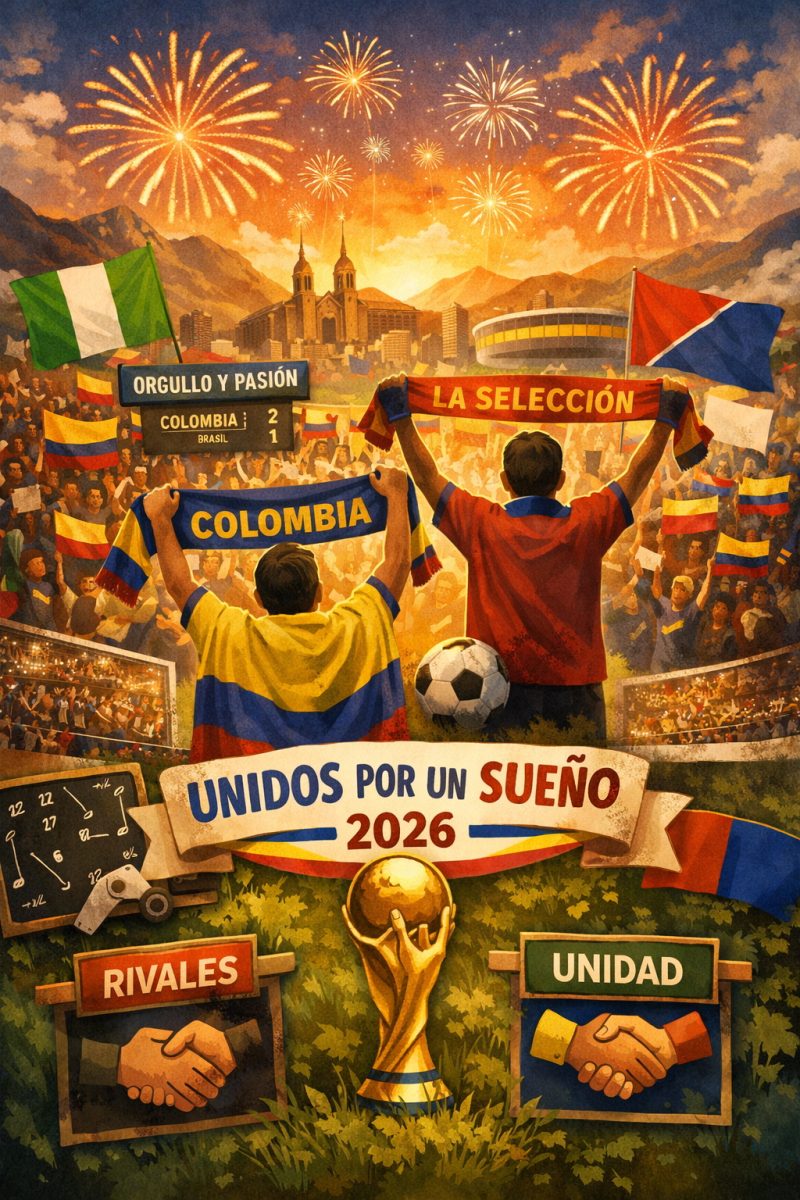
Expectations for the Colombian national team’s 2026 World Cup run vary depending on who you ask. Through the shared thoughts of various members of the TCS community, different views emerge about optimism, pressure, and the cultural impact of La Selección. As a Colombian community with a strong soccer culture, TCS teachers and students regularly follow and passionately discuss Selección Colombia and its journey to the World Cup.
For Emilio Ángel, an 11th grader and member of Los del Sur, Atlético Nacional’s popular fan base, recent performances have built confidence in the team.
He explained, “I think the results have raised my expectations a lot… Now, with players like Luis Díaz, with his tactical intelligence and speed developed at Bayern München, and Daniel Muñoz, who keeps smashing records in the Premier League, among others, we have a really strong group, which makes me more optimistic.”
His outlook reflects a renewed sense of belief among supporters who see the current squad as competitive.
Emilio’s expectations also extend to tournament performance. He said, “My expectation is that Colombia reaches at least the quarterfinals.” While ambitious, his goal reflects optimism shaped by recent results and confidence in the team’s talent. Beyond results, he also emphasized the social effect of national team matches, noting that “When the national team plays, people change a little and come together more to celebrate and support Colombia.” His perspective highlights football’s ability to reduce tensions and bring rival supporters together. He also acknowledged that unity is not perfect, explaining that “Even though there are still problems between rival fans, during Colombia games people try to be more united and focus on supporting the national team.” This reinforces the idea that the Selección creates moments of shared identity despite existing rivalries.
Another student offered a similarly emotional perspective on unity. Esteban Ortega, an 11th grader and fan of Independiente Medellín, Atlético Nacional’s historic city rival (their matches are known as the Medellín Derby), recalled a defining emotional moment: “One moment I particularly remember is Colombia beating Brazil 2–1 in Barranquilla.” For him, memorable victories like this shape expectations and strengthen belief in the national team’s potential, especially when defeating teams that have previously been world champions.
Esteban also reflected on football’s broader cultural influence. He explained that “Colombia is usually very divided among regions and even among local soccer teams… when Colombia plays, there is a strong sense of unity and community across the country.” His comments show how the national team can create shared national pride that goes beyond club rivalries. At the same time, he acknowledged the pressure fans place on players, stating that “Colombian fans have very high standards for our players, especially because many of them play in Europe.”
We also asked Norberto Villa, a high school Spanish teacher who never misses a Nacional match, for his perspective on La Sele. Unlike the student interviewees, Villa’s comments reflect a more experienced and critical lens on the national team’s performance and expectations. He argued that qualification itself should be viewed with caution, explaining, “It was practically impossible that Colombia wouldn’t qualify, especially when seven out of ten teams advance.” His view challenges the idea that simply reaching the World Cup is a major achievement.
Despite his criticism of the 2026 World Cup qualifiers, Norberto emphasized the deep connection between Colombians and their national team. He said, “Colombians have internalized their love for the national team and support it until the impossible, accompanying it anywhere in the world.” This highlights the passion and dedication that define Colombian fan culture. He also reflected on football’s broader meaning, stating that “Football is a universal language and probably the most democratic thing that exists.”
Unity, despite strong club rivalries, emerges as the central theme across these interviews, showing how the national team creates common ground even among opposing fans. Together, these perspectives show how expectations for Colombia’s 2026 World Cup run combine optimism, pressure, and reflection. For some, La Selección represents unity and hope. For others, it raises questions about standards and success. Across all viewpoints, however, the national team remains a powerful symbol that connects people through a shared love of football.
Ángel, Ortega, and Villa offer different but connected perspectives that reflect the diversity of opinions within Colombian football culture. For The Columbus School community, La Selección is more than a team; it is a shared passion that brings students, teachers, and fans together in moments of pride, conversation, and national identity.