


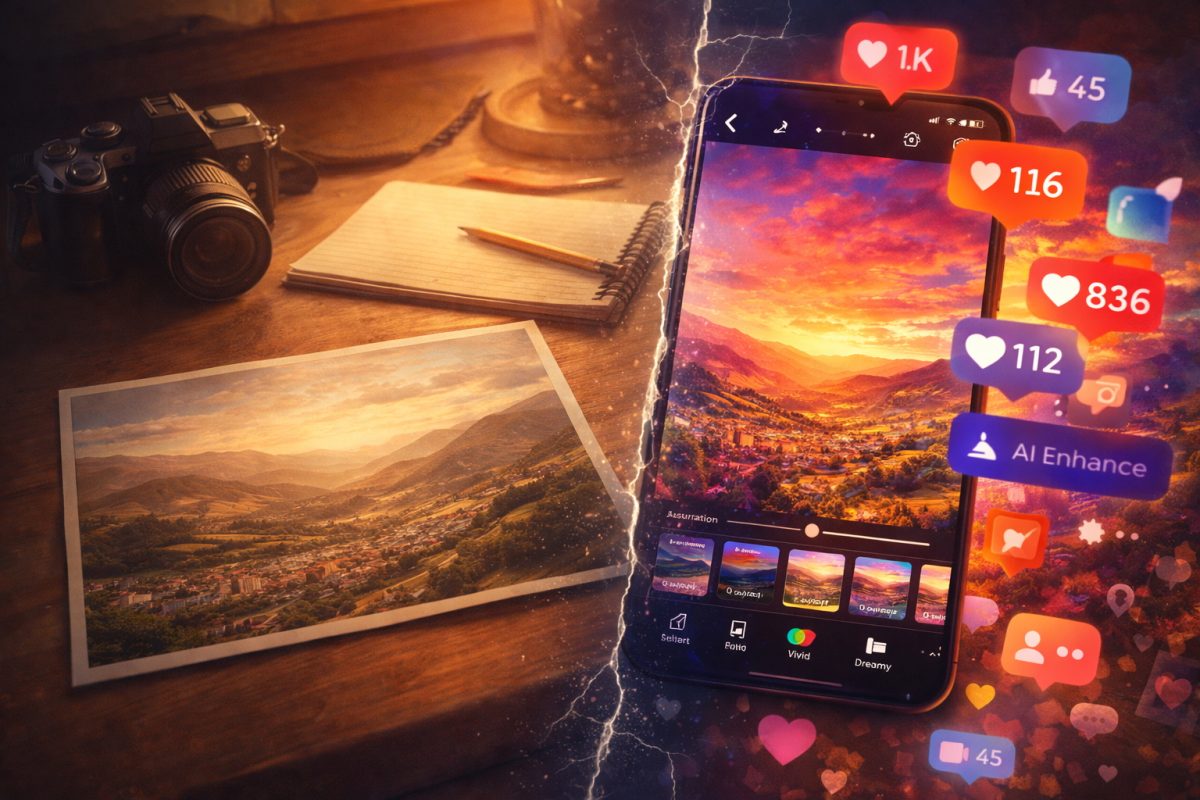
Images on social media are powerful, but they can also blur the line between what is real and what is edited. Several students and teachers in the school community shared how photo editing, online popularity, and social media standards affect the way people see themselves and others.
Mr. Andrew Shainker reflected on how online images can distance people from reality. “I think the images that we try to portray are sometimes no longer even looking like ourselves,” Shainker said. While he does not reject photo editing entirely, he warned about how quickly it is advancing. “There’s nothing wrong with enhancing an image or learning photo editing, but we have to realize that if the internet is moving at the speed that it is, in a few years, it will be very hard to tell what’s real, what’s authentic, and what’s manipulated. It’s going to get worse and worse,” he explained.
Because of that, Shainker encourages students to learn responsibly. For example, if AI tools are used in an image, he suggests including that information in the description so viewers do not try to achieve something that does not exist. “I would encourage students to make sure that if they want to learn photo editing and the power of photography, they learn these basics and then use these tools to enhance,” he said.
Learning photography can be beneficial because it allows people to tell stories, reach larger audiences, and build a personal brand. Taking photos is a powerful tool, and when used responsibly, it can help students communicate ideas creatively while staying authentic.
Students also shared how edited images and online popularity affect expectations. Miguel Gomez, an 11th-grade student at The Columbus School, spoke about how people often appear more impressive online. He said they “probably appear with likes and looks and views,” but that perception can change when meeting someone in real life. He mentioned examples of people who “edit their photos maybe better, showing things that aren’t really what they are,” and how seeing them face to face can be disappointing.
This disappointment connects to the idea of “catfishing,” when someone presents themselves online as something they are not. When expectations are built on edited or unrealistic images, it can create high standards and possibly lower someone’s self-esteem when reality does not match what was presented.
Miguel also pointed out that adults often talk to students about social media but may not fully understand it. He said that sometimes “they’re in denial about it in a way,” even if their intentions come from wanting memories or meaning. This denial may come from not fully understanding how social media affects teenagers. At the same time, some students take social media use to an extreme, focusing more on capturing the perfect picture than living in the moment and experiencing it fully.
For others, the issue goes beyond images and into how social media affects relationships. Emiliana Fernandez, a 12th-grade student at Marymount School, explained that social media influences how people are viewed by others. “I think it’s where popularity or how people from outside of social media view you,” she said. She added that what people post can help interests be discovered and bonds be formed, but it can also lead to judgment and bullying.
Julia Faccio, a 12th-grade student at Marymount School, shared how these platforms can quietly shape self-worth. “I feel like, as a society, we have set interactions on social media as this standard from which we get the appreciation of other people,” Faccio said. When that appreciation is missing, she explained, “it does change unconsciously how we feel about ourselves.”
Faccio also described a personal moment of pressure, saying she felt the need to change her appearance when “about every teenage girl around me started dyeing their hair blonde or doing highlights,” which made her feel like she had to change her hair to fit in. This reflects a common experience among teenagers, where trends grow quickly and social media can create pressure to look or act a certain way.
Together, these perspectives show that social media is not just about photos and posts. It influences identity, confidence, and relationships, often in subtle ways. As images become easier to edit and standards harder to meet, students and teachers agree that awareness and responsibility matter more than ever. Taking a good picture and learning how to edit is not something negative. It is a valuable skill that can last a lifetime, but it must be used responsibly.