


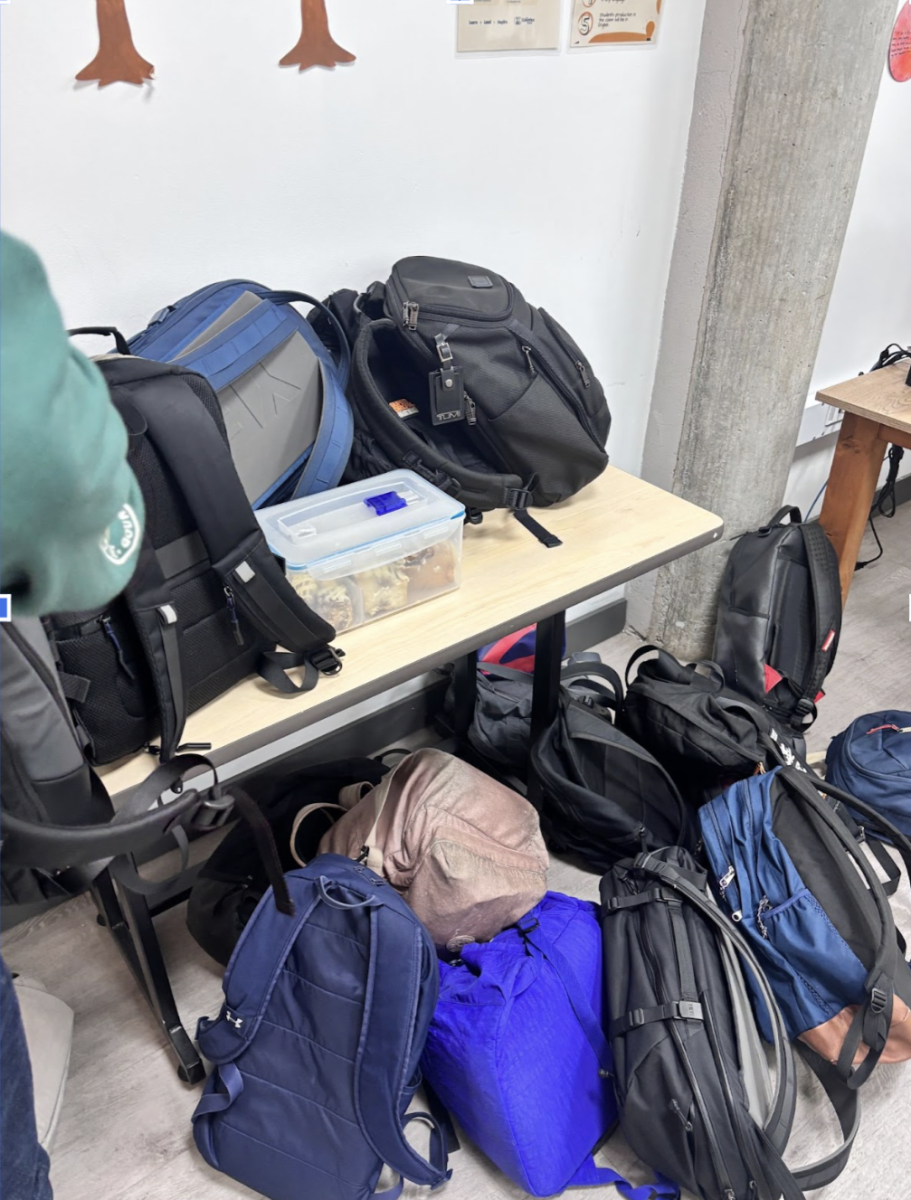
Between classes, the hallway fills with movement, students rushing, talking, and trying to make it to their next destination in under five minutes. But just inside one classroom, a different scene unfolds: backpacks stacked on desks, piled on the floor, and lining the walls. What used to be a place for learning has quietly become something else, an unofficial locker room. This growing habit raises an important question: why are students choosing classrooms over lockers, and what does this say about how schools are organized today?
In many schools, lockers were once essential. They symbolized independence and responsibility, giving students a personal space to manage their belongings. However, as technology has reduced the need for heavy textbooks and tight schedules have made time more limited, locker use has declined. Instead, students are adapting in ways that better fit their daily routines. One of the clearest examples of this shift is happening in Camo’s classroom, where students regularly leave their backpacks instead of using downstairs lockers.
For students, the main reason is simple: convenience. As Daniel Franco explains, “The reality is that it’s practical, it’s very practical to leave your backpack there because it’s easy to grab it and go to the cafeteria and back”. His words highlight how efficiency drives decision-making during the school day. With limited transition time, students naturally look for ways to save time and effort.
Beyond convenience, students also value safety. Franco adds, “Camo’s room is also a safe place where you know nothing will happen to your backpack”. This sense of security reinforces the habit, as students trust the classroom environment more than shared locker spaces. Additionally, routine plays a role. Franco notes, “If I’m already in his classroom, I can just leave my backpack there and go to my other classes”. In this way, familiarity and daily patterns make the classroom a logical storage choice. Similarly, Matias Gaviria emphasizes efficiency over tradition. He argues, “I don’t think leaving backpacks in classrooms weakens responsibility, it’s just the most convenient and efficient thing we can do”. This perspective challenges the idea that lockers are necessary for student development. Instead, Gaviria suggests that practicality should guide behavior.
Time pressure is another key factor. Gaviria explains, “It helps us get to lunch or break faster and avoid long lines, especially since we have limited time between classes”. This highlights a larger issue within school systems: schedules often do not allow enough time for students to move between distant locations. As a result, students adapt by choosing the fastest option available. Gaviria reinforces this point by stating, “It’s simply more convenient to leave our things in a place that’s closer to where we are during the day”.
From a teacher’s perspective, however, the situation looks different. Camilo Hoyos explains that this behavior is not random but rooted in the classroom’s design and location. He notes, “Students leave their backpacks here because the room is closer to the exit than their lockers, making it a more convenient option.” This reinforces the idea that the physical layout of the school influences student behavior. Hoyos further explains, “The classroom’s location makes it more likely to function as an unofficial locker space. Students naturally choose the most efficient option available to them.”
Taking this idea even further, Hoyos connects student behavior to a broader principle: “One of the fundamental principles in nature is the economy of energy, organisms act in ways that conserve and optimize energy. Humans are no exception.” This insight suggests that students are not intentionally rejecting lockers, but rather responding logically to their environment. In other words, the problem may not be student behavior, but the system itself.
Despite these practical benefits, the shift away from lockers is not without consequences. The image of backpacks piled across the classroom shows clear issues with space and organization. What begins as a convenient solution can quickly become cluttered and chaotic. When multiple students leave their belongings in one place, it creates obstacles that can interfere with movement and safety. Students must carefully step around bags, increasing the risk of accidents or damage.
Additionally, this practice can disrupt classroom routines. Teachers may have to wait for students to collect their belongings or rearrange items to create space. While students see efficiency, teachers often experience inconvenience. This contrast highlights a key tension in the debate: what works for students in the short term may create challenges for the overall learning environment.
At the same time, the argument that lockers promote responsibility cannot be ignored. Lockers encourage students to plan ahead, organize their materials, and manage their time effectively. By avoiding lockers, students may miss opportunities to develop these skills. However, as Gaviria suggests, responsibility is not necessarily determined by where students store their belongings, but by how they manage their time and actions. To address this issue, schools may need to find a balance between convenience and structure. One possible solution is to reconsider locker placement. As Hoyos suggests, if lockers were located closer to high-traffic areas, students would be more likely to use them. Another option is to create designated storage spaces within classrooms that are organized and supervised. These changes could maintain efficiency while reducing clutter and safety concerns.
Ultimately, the shift from lockers to classroom storage reflects a broader change in how students interact with their environment. It is not simply about backpacks, but about how systems adapt, or fail to adapt to modern needs. Students are choosing what works best for them, even if it means redefining traditional practices.
In conclusion, while students prefer leaving their backpacks in classrooms like Camo’s because it is more convenient, this habit reveals deeper issues with school design, time management, and organization. Lockers may seem outdated, but they still serve an important purpose in maintaining order and encouraging responsibility. Rather than abandoning them completely, schools should focus on improving their accessibility and relevance. By doing so, they can create a system that supports both efficiency and structure, ensuring that classrooms remain spaces for learning, not storage.