


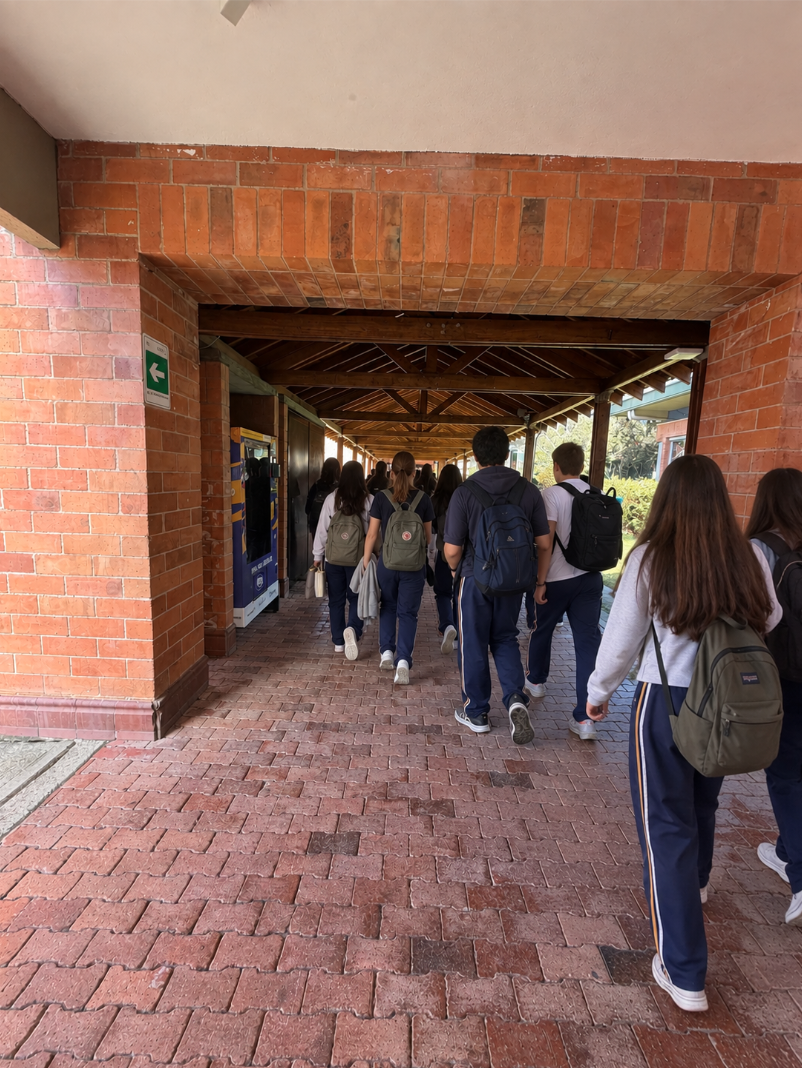
As year group sizes increase, administrators have had to revise timetables, hire additional staff, adjust budgets, and repurpose or add classrooms to address the logistical, financial, infrastructural, and staffing challenges larger year groups bring.
One example of this is the “F Classroom” project, which began over a decade ago as the school adapted to its growing student population. The school’s administrative and financial manager, Elen Yepes, explained, “More than a sudden destabilization, the great transformation story that the school has experienced is the creation of the ‘F classroom’ project. This project began in 2011 in K4, where one more room was added per grade, and it scaled year by year until it covered the entire school (from K4 to 12), and this ended 2 years ago.” (Translated from Spanish)
The increase in the student population not only made the school adjust enrollment management. It also placed an unforeseen amount of pressure on the school’s architecture and infrastructure, since a large part of the facilities were built for a smaller population. According to Yepes, an increase of roughly 350 students has created significant challenges that were not always addressed or visible in the planning stage, including fuller hallways in Middle School and High School during transitions, faster filling of the parking bay during drop-off and pick-up, and generally changed dynamics in common areas like the cafeterias and the athletic courts. Yepes adds, “Architecturally, some spaces in the school were designed for a smaller population. Today, with more students, hallways, common areas, and green spaces present a challenge for coexistence, especially during breaks, class transitions, and when students leave for home.” (Translated from Spanish)
Consistent pressure like this can lead to strains in the physical infrastructure and compromise student safety in common areas. As a consequence, this forces the school to spend more resources overall on staffing and general upkeep. Finally, Elen said that “A larger class requires the school to invest globally in more human talent (more teachers and counselors, among others) and in greater maintenance of the spaces that we all enjoy daily.” (Translated from Spanish)
These unseen administrative and financial changes will eventually end up dictating the behavioral limits and social environment within the student population. High School Principal Paul Navarra said that “We have noticed that the less crowded the cafeteria is, the better students behave. So that has been a situation where the year sizes have influenced student discipline. I would say, though, that the most important issue is class size, and that is why we limit the class size maximum to 25 students.”
Controlling these numbers to improve behavior is a perpetual challenge, which is why it requires carefully crafted planning and restructuring. Additionally, Navarra recounts how, “Two years ago was the first year that we had every grade level with all 6 sections. In preparation for that, we determined that we needed 3.5 additional positions.”
Ensuring a growing student population’s needs can be met is a continuous process that grows and changes with the student body itself. Ultimately, Navarra assures that “We are constantly revising our staff and student numbers to find the best balance so that we can have an optimal learning environment in the HS for all.”
As the school continues to evolve to ensure the best environment possible for its students, the initiative’s success will depend, at its core, on balancing physical expansion with the additional personnel needed to reinforce and sustain it.