


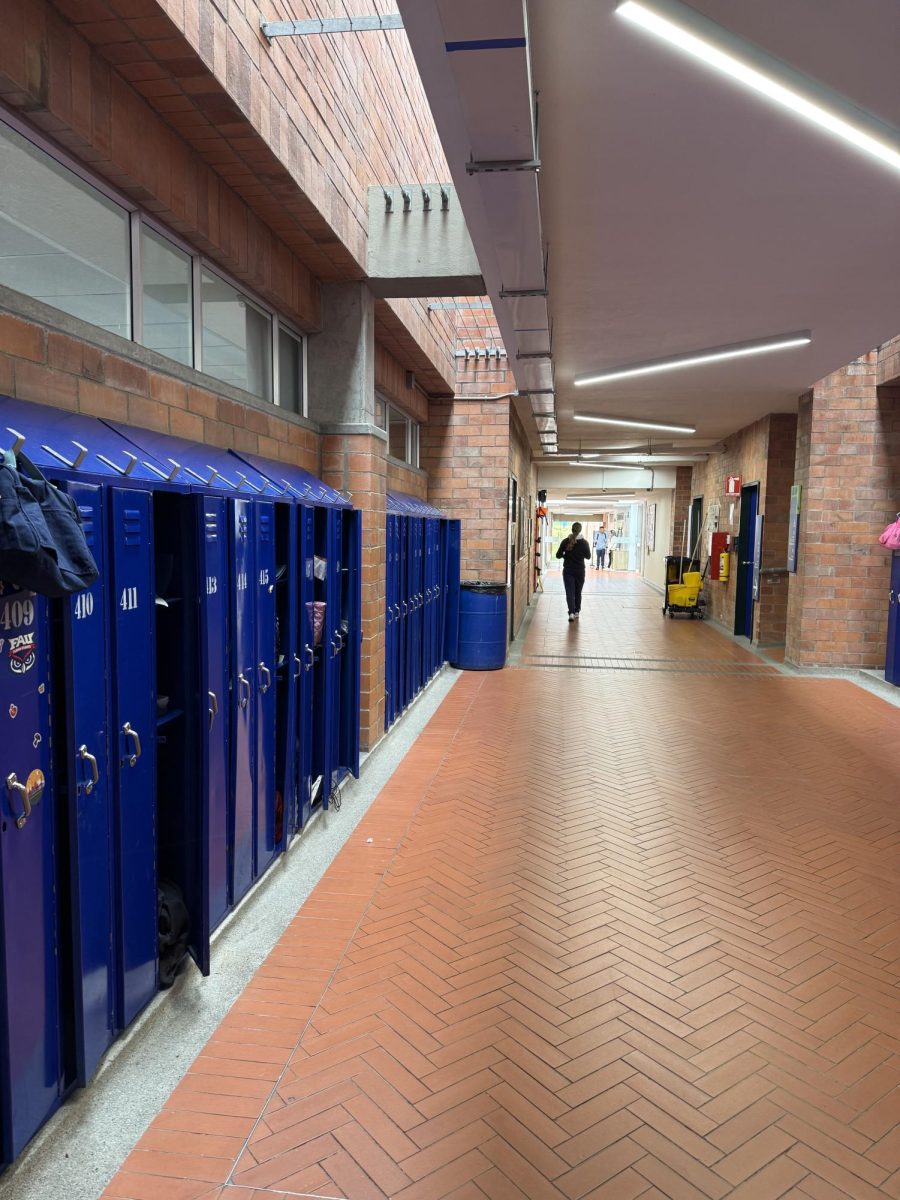
The passing period may seem like a small part of the school day, but it actually reveals a lot about student life. The hallway photo captures a moment when students are balancing many things at once: walking to class, talking with friends, and trying not to be late. Even though the time is short, this transition between classes plays an important role in the daily rhythm of school.
One of the most noticeable things in the hallway during passing period is how quickly everything happens. Students leave their classrooms at the same time, and the corridors suddenly become crowded. Because of this, many students feel that the time goes by very fast. Alicia Baquero, a 12th grader, explains that “for me the five-minute break between classes is really short because sometimes you need to go to the bathroom and go to a class that’s very far away”, which highlights how limited the time can feel in practice. She also adds that “those five minutes go by really fast,” reinforcing the shared experience of students rushing through the halls.
In addition to the lack of time, students often feel increased pressure during these transitions. Alicia admits that “it increments my stress because I’m thinking about 100 things at the same time and I have a lot of to-dos,” showing how the passing period is not only physical movement but also mental overload. Because of this pressure, she explains that “I know I have to go directly to the other class if I want to arrive on time,” demonstrating how students must constantly prioritize punctuality over anything else.
Even though the passing period is short, it is also an important time for students to interact socially. Many students use this moment to talk with friends they may not see during class. Elisa Isaza, an 11th grader, shares that passing period carries responsibility, explaining that “as a grade eleven student I feel like switching classes is a great responsibility because I need to be on time for all my classes.” At the same time, she recognizes the social and emotional challenges of the day, noting that “my stress with all my homework and everything just increases because I have a life after school.”
The hallway photo reflects this balance between social interaction and responsibility. Students are walking side by side, some talking while others move quickly toward their classrooms. Elisa adds to this idea by agreeing with other students’ experiences, saying that “I agree 100% with those students, but the majority of the time I need to basically run from one class to another,” which illustrates how even social moments are often rushed.
However, not everyone views the passing period in the same way. Some people believe that the limited time between classes can create stress for students. Claudia Lalinde, a parent, shares this concern by explaining that “it’s normal to come home tired and stressed after a day of school, but being in a rush can contribute to this stress.” Her perspective highlights how the effects of a busy school schedule extend beyond the classroom and into students’ well-being at home.
Claudia also points out that the short time limit may not be realistic for students, saying that “she is never able to complete one task in five minutes,” which suggests that the structure of the schedule itself may be part of the problem. She further reflects on the broader impact of constant rushing, emphasizing that “being rushed all day is not a good thing—that is not what life is about.” This comment challenges the idea that the passing period is simply a normal and harmless part of school life.
Even though the passing period lasts only a few minutes, it plays an important role in the daily experience of students. It allows them to move between classrooms, briefly connect with friends, and mentally prepare for the next lesson. The hallway photo captures this moment of movement and interaction, showing how much activity happens in such a short time.
In the end, the five-minute passing period represents more than just a break between classes. It reflects how students manage their time, maintain friendships, and navigate the busy environment of school. Through the experiences of Alicia Baquero, a 12th grader, Elisa Isaza, an 11th grader, and Claudia Lalinde, a parent, it becomes clear that these few minutes are a meaningful and sometimes stressful part of the school day.